Coaching vs Mentoring vs Consulting vs Therapy: What's the Actual Difference?
Géraldine Gauthier
05 May 26
|
10 Minutes
|
I get this question constantly from leaders who want to develop their teams, from professionals considering a career change, from organisations trying to figure out what kind of support their people actually need.
Is coaching the same as mentoring? Is my therapist coaching me? If I give advice, am I still coaching?
The confusion is understandable. These four disciplines overlap in places, borrow from each other, and are often marketed interchangeably. But they are not the same thing. Conflating them leads to real problems: the wrong kind of support at the wrong moment, practitioners overstepping their lane, and clients who don't get what they actually need.
I've worked across several of these disciplines finance, personal training, NLP, and now over a decade as a certified coach, including at the Master Certified Coach (MCC) level. Here's how I actually distinguish them, stripped of the marketing language.
The Core Distinction Nobody Explains Clearly
Before going into each discipline, one principle cuts through most of the confusion:
The difference isn't what you discuss. It's where the expertise lives.
In consulting and mentoring, the expertise lives with the practitioner. They know things you don't, and the value of the relationship comes from transferring that knowledge to you.
In coaching, the expertise lives with the client. The coach's job is to help you access your own thinking, challenge your assumptions, and move toward what you've decided matters. A coach who gives you the answer has just become a consultant.
In therapy, the expertise lives in the therapeutic relationship itself and in the clinician's understanding of psychological processes that are often outside the client's conscious awareness.
That's the skeleton. Now the detail.
What Coaching Actually Is
Professional coaching particularly ICF-credentialed coaching is a structured, forward-focused conversation that helps someone close the gap between where they are and where they want to be.
The coach doesn't tell you what to do. Doesn't share their experience. Doesn't evaluate your performance. Instead, they ask questions that help you think more clearly, notice assumptions you've been operating under, and make decisions that are genuinely yours.
What makes this harder than it sounds: most people in positions of influence managers, consultants, trainers, experienced professionals have been rewarded for having the answers. Coaching requires a different instinct entirely. You have to trust that the person in front of you is capable of finding their own way, even when you can see exactly where they're stuck.
At its best, coaching is transformational. Not because the coach does something to the client, but because the quality of the space creates the conditions for the client to do something to themselves shift a belief, commit to a decision, face something they've been avoiding.
Coaching is most useful when:
- Someone is capable and resourceful but stuck, unclear, or underperforming relative to their potential
- The goal is behavioral change, not just information transfer
- The person needs to own the solution for it to actually stick
- The challenge is navigating complexity, not solving a technical problem
What coaching is not: advice-giving, feedback delivery, performance management, or crisis support.
What Mentoring Actually Is
Mentoring is the transfer of wisdom from someone who has walked the path to someone who is walking it now.
A mentor has been where you are. They've made the mistakes, navigated the politics, built the thing you're trying to build. The value is that they can help you avoid reinventing the wheel, make better decisions with fewer data points, and understand what's coming before you get there.
Good mentoring is conversational, honest, and often unsolicited — a mentor who waits to be asked is usually less useful than one who knows when to say, "I've seen this before, here's what happened."
Unlike coaching, giving advice in mentoring isn't a failure of the model. It's the whole point. You go to a mentor because of who they are and what they've done, not because of their ability to hold a neutral space.
The risk in mentoring is projection. A mentor who assumes their path is the right path, or who gives advice based on their own unresolved experiences, can be genuinely harmful. The best mentors know how to distinguish between "what worked for me" and "what's right for you."
Mentoring is most useful when:
- Someone needs domain knowledge or industry wisdom they don't have access to
- Navigating an organization's politics or culture
- Making decisions that benefit from experience-based pattern recognition
- Building a career in a field where the mentor has genuine expertise
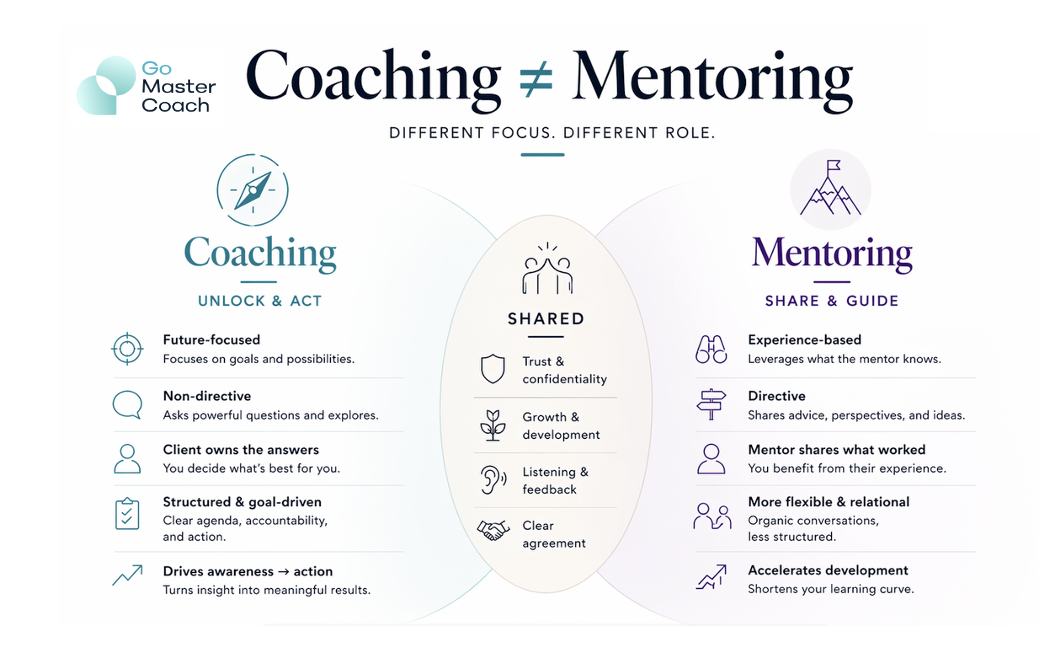
Differences between coaching and mentoring
What Consulting Actually Is
A consultant is hired to solve a specific problem. They bring expertise, diagnose a situation, and recommend or implement a solution.
The client pays for the consultant's knowledge and methodology. The client's role is to provide context, make decisions, and implement. The consultant's role is to be right.
This is a completely legitimate and valuable model. The problem comes when it's applied in situations that call for a different approach. If a manager consults when they should be coaching, they solve the immediate problem while simultaneously undermining the team member's ability to solve it themselves next time. Dependency goes up. Ownership goes down.
I see this constantly in organizations: leaders who are technically brilliant, who care deeply about their teams, and who keep removing the thinking from people by being too helpful too fast. The team learns to bring the manager their problems because the manager always has the answer. The manager becomes a bottleneck and wonders why no one takes initiative.
Consulting is most useful when:
- There is a specific technical problem that requires specialist expertise
- Speed is more important than ownership and learning
- The client doesn't have the capability to solve the problem independently, and that's okay
- The deliverable is an output (a strategy, a system, an analysis), not a development
What Therapy Actually Is
This is where the boundaries matter most and where the most damage is done when they're ignored.
Therapy (psychotherapy, counselling, clinical psychology) is a licensed clinical practice. Its scope includes diagnosing and treating mental health conditions, processing trauma, working with deeply held psychological patterns that are often outside a person's conscious awareness, and supporting people through mental health crises.
Therapy looks at the past to understand the present. It can be long-term, intensive, and it works with material, memories, emotions, developmental experiences, that is out of scope for coaching.
The critical boundary: coaching is not therapy, and coaches are not therapists.
A coach working with someone in the middle of a mental health crisis, someone with unprocessed trauma that is clearly driving their presenting issue, or someone who needs clinical support — is operating outside their competency. This is true even if the coach is empathetic and intelligent and means well.
What makes this complicated is that the line isn't always obvious. Coaching conversations can touch deep material. Emotions come up. Sometimes a coaching client is dealing with something that belongs in a therapeutic context.
Good coaches know how to recognise when that's happening and how to refer appropriately without it feeling like rejection. This is actually part of the ICF ethical standards: coaches are expected to refer clients to appropriate professionals when the work exceeds the scope of coaching.
Therapy is most useful when:
- There are clinical mental health concerns: depression, anxiety, trauma, addiction
- Past experiences are significantly driving present-day patterns in ways the person can't access through reflection alone
- Someone needs a licensed, regulated clinical practitioner
- Crisis support is needed
Where It Gets Complicated
In practice, these disciplines blur and that's not always a problem.
A mentor might shift into coaching mode when they realize their mentee doesn't need advice, they need to think something through. A therapist trained in coaching tools might use them to help a stable client clarify their goals. A consultant with coaching skills will facilitate better than one without them.
The question isn't whether these things ever overlap. They do. The question is whether the practitioner knows what mode they're in, why, and whether it serves the person in front of them.
Leaders who develop coaching skills — the ability to ask better questions, listen without agenda, create space for people to reach their own conclusions — become dramatically more effective managers. Not because they're running coaching sessions with their team. Because they've internalized a different way of relating to the people around them.
This is actually one of the strongest arguments for formal coach training: it doesn't just make you a better coach, it makes you a better leader, communicator, and human being in every context.
So Which Does Your Situation Call For?
A few questions that help locate the right approach:
Does the person need to own the solution? If yes, coaching. If the solution can come from outside and still work, consulting or mentoring may be faster.
Is this about performance and growth, or about a specific technical problem? Growth → coaching. Technical problem → consulting.
Does the person have experience gaps that need filling? Yes → mentoring alongside (or instead of) coaching.
Is what's happening primarily psychological — involving mental health, trauma, or clinical patterns? If yes, a qualified therapist is the right referral, not a coach.
Does the person know what they want but need help thinking through how to get there? That's coaching territory.
A Note on "Life Coaching"
Since people always ask: "life coaching" is not a recognized professional category in the ICF framework. The ICF credentials coaches, not specializations.
What most people call a "life coach" is simply a coach whose clients tend to bring personal rather than professional goals. The level of training, ethics, and competency required is the same. An ACC-credentialed coach working on personal goals is a life coach. An uncredentialed person calling themselves a life coach is something else.
If you're looking for a coach in any area the most important check is credentialing. Look for ICF ACC, PCC, or MCC. It means they've been trained, assessed, and held to a professional standard.
Frequently Asked Questions
Can a coach also be a mentor?
Yes, in different relationships or at different moments. The key is knowing which role you're in and being transparent about it. Mixing both in a single conversation without clarity often serves neither well.
Is executive coaching the same as regular coaching?
The coaching methodology is the same. The context is different, executive coaches typically work with senior leaders on leadership, strategy, and organizational impact. Executive coaches are often expected to have business acumen alongside coaching competency. Many hold PCC or MCC credentials.
Can my manager coach me?
Leaders can use coaching skills effectively. But there are real limitations to a coaching relationship with a direct report: the manager has a stake in the outcome, they hold evaluative power, and the employee knows it. This doesn't make coaching skills useless for managers, it makes full coaching relationships between managers and direct reports structurally complicated.
Is NLP the same as coaching?
NLP (Neuro-Linguistic Programming) is a set of techniques and frameworks that some coaches integrate into their practice. It is not the same as professional coaching. Some coaches use NLP tools; many excellent coaches don't. NLP is not a regulated profession and does not carry the same credentialing structure as ICF coaching.
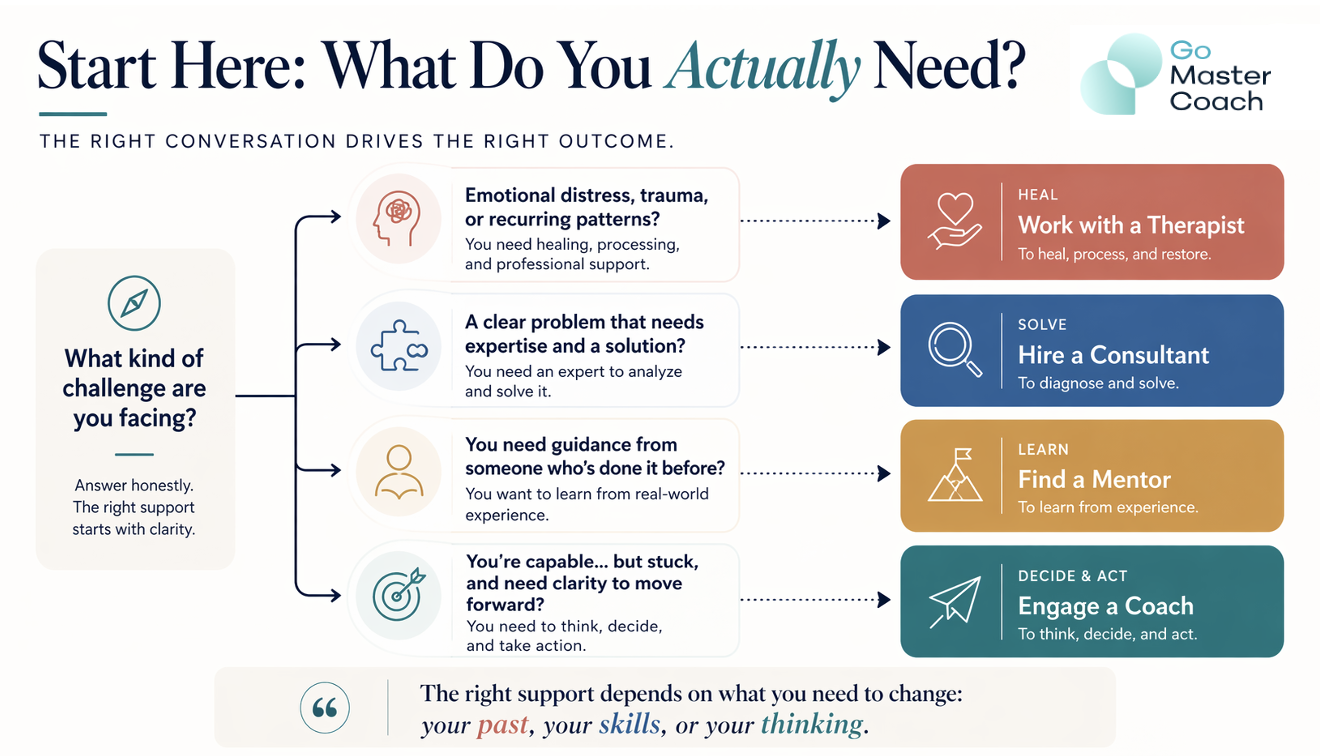
How do I know if I need a coach, mentor, consultant, or therapist?
Start with the question: what is the nature of my challenge?
Technical problem with a definable solution → consultant.
Knowledge and wisdom gap → mentor.
Capable but stuck, unclear, or wanting to grow → coach.
Mental health concern, trauma, or clinical pattern → therapist.
Many people benefit from more than one at different stages.
What do you actually need?
Where can I train to become a professional coach?
Look for ICF-accredited programs either Level 1 (for ACC credentials) or Level 2 (for PCC credentials). These are the internationally recognized standards for professional coach training. GoMasterCoach offers both, with global cohorts in English and French, and mentoring embedded inside every program.
The Bottom Line
Coaching, mentoring, consulting, and therapy are four distinct disciplines. They serve different needs, operate on different principles, and require different qualifications.
Coaching is not better than the others. It's specific. It works when the person is resourceful, when the goal is their own development, and when the solution needs to belong to them to be real.
Knowing the difference matters, whether you're choosing the support you need, developing your team, or building a practice.
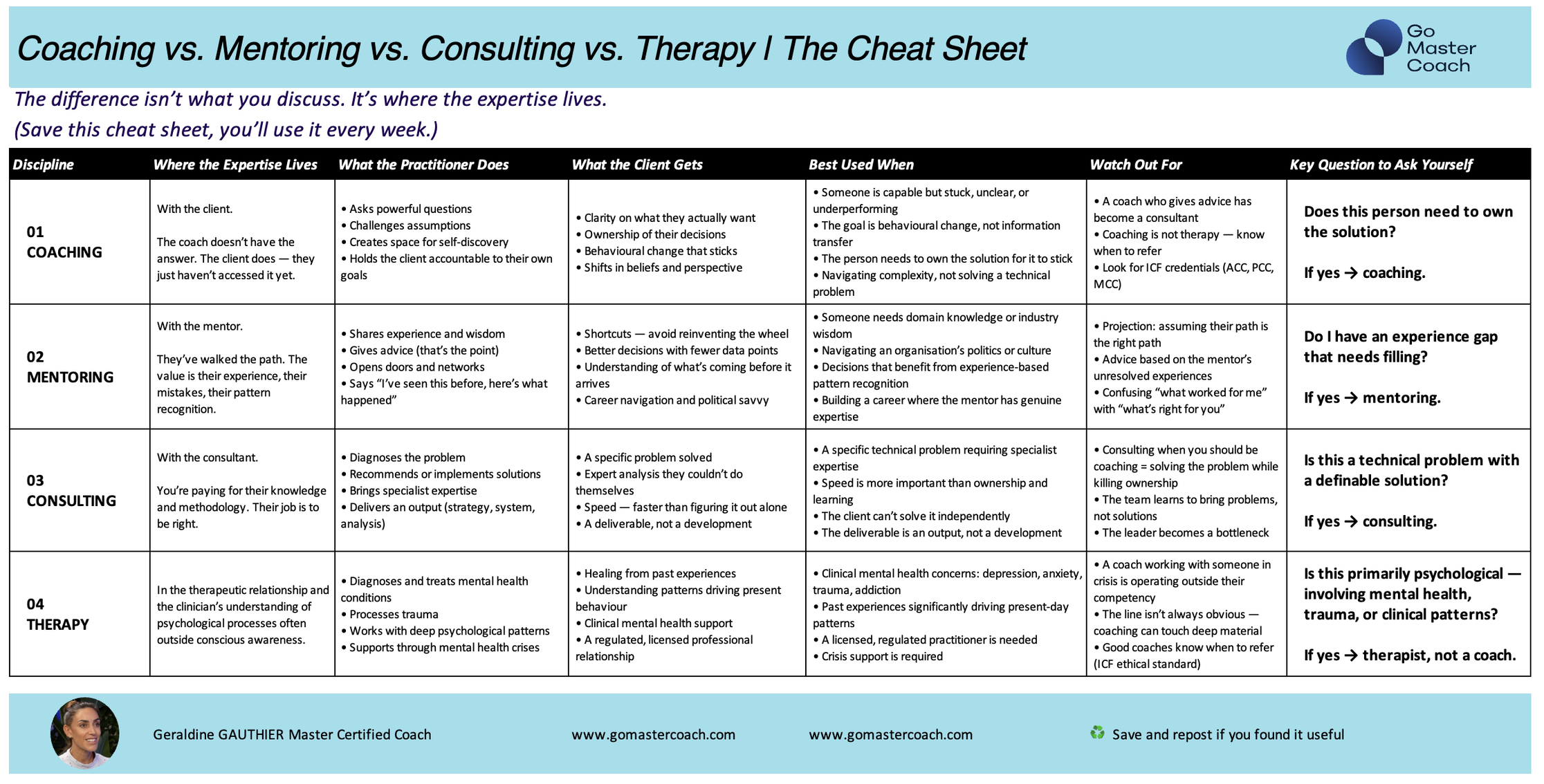
The Cheat Sheet : Difference between Coaching Consulting Mentoring Therapy
If you want to develop real coaching skills, not a certificate, actual competency, that's what GoMasterCoach is built to do.
Geraldine GAUTHIER MCCis a Master Certified Coach (MCC), ICF mentor coach, and founder of GoMasterCoach, a global coaching training platform with programs across Singapore, Europe, and the US. She has worked across coaching, NLP, finance, and personal development, and has trained coaches around the world.

.svg)

.svg)
.webp)


.webp)





.jpg)



.jpg)