Understanding the Differences Between Coaching, Mentoring, Therapy, and Consulting: A Comprehensive Guide
Géraldine Gauthier
13 Sep 24
|
6 min read
|
In the fast-evolving world of professional development and personal growth, the lines between coaching, mentoring, therapy, and consulting often blur. With managers assuming they’re coaches when offering advice, clients hiring coaches expecting mentorship, or coaches straying into therapeutic territory without adequate training, it’s no wonder that confusion abounds. Misunderstanding these roles can lead to poor support, ineffective results, and frustration for both the professional and the client.
If you’ve ever been unsure about whether you need a coach, mentor, therapist, or consultant, you’re not alone. Each role serves a distinct purpose, and understanding these differences can help you get the most out of the support you seek.
In this article, we’ll clear up the confusion by providing a clear distinction between coaching, mentoring, therapy, and consulting. We’ll explore the unique benefits each role offers and help you determine which type of support is right for your personal or professional growth.
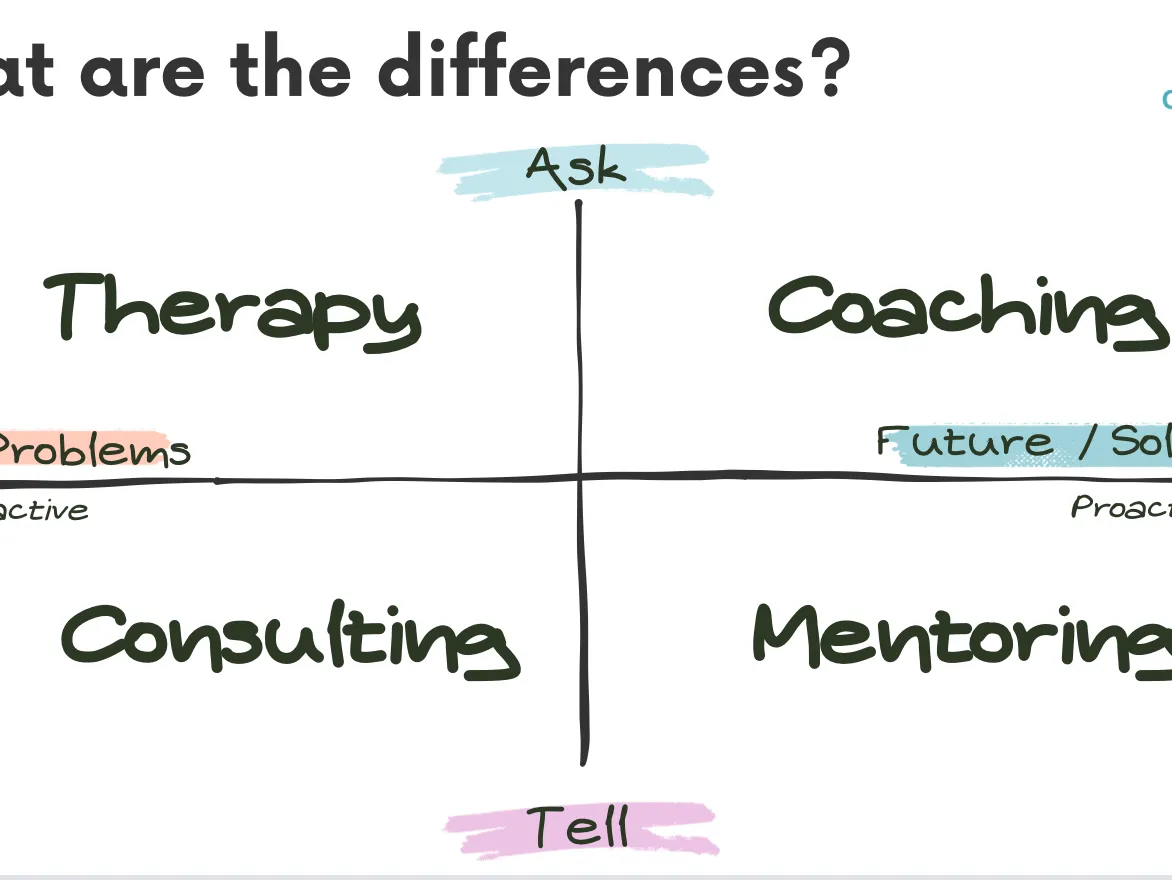
Differences between Coaching, Mentoring, Consulting and Therapy
The Consultant: The Expert Who Solves Specific Problems
Definition:
A consultant is an expert in a specific field, brought in to provide professional or technical advice. Their primary role is to analyze a situation, identify issues, and recommend solutions. Consultants typically focus on short-term, tangible outcomes and are hired to address specific problems within an organization or business.
Key Characteristics of Consulting:
Expert-driven: Consultants are usually specialists in their field, providing advice based on their extensive knowledge and experience.
Problem-solving: Their work is typically focused on diagnosing problems and offering solutions.
Short-term engagement: Consulting is often project-based with a defined beginning and end.
Actionable advice: Consultants deliver practical, actionable strategies that the client can implement to resolve specific issues.
Minimal focus on personal development: The emphasis is on solving a problem rather than helping the client develop personally or professionally.
When to Seek a Consultant:
You have a well-defined problem that requires an expert’s analysis and recommendation.
You need specialized knowledge or technical expertise to solve a specific issue.
You want a solution-focused approach with clear, actionable steps.
Example:
Imagine your business is struggling with digital marketing. A consultant would come in, assess your current strategies, and provide a detailed plan to improve your online presence, increase lead generation, or optimize your advertising spend. Their goal is to fix a specific problem with their specialized knowledge.
The Mentor: A Guide Who Shares Wisdom and Experience
Definition:
A mentor is an experienced individual who provides guidance and support to a less experienced person. Mentorship is often focused on long-term personal and professional development, where the mentor shares their knowledge, experiences, and insights to help the mentee navigate challenges and opportunities.
Key Characteristics of Mentoring:
Experience-based: Mentors share knowledge gained from their personal and professional journeys.
Long-term relationship: Mentorship often lasts for an extended period, allowing for ongoing support and development.
Focus on guidance: Mentors don’t provide direct solutions but rather guide the mentee toward making informed decisions.
Mutual growth: Both the mentor and mentee often experience growth through the exchange of ideas, experiences, and feedback.
Career or personal development: The mentor focuses on helping the mentee achieve their goals, whether related to career advancement or personal growth.
When to Seek a Mentor:
You’re looking for long-term personal or career growth.
You want someone who has "been there, done that" to share their wisdom and experiences.
You’re seeking guidance, not answers, and prefer a relationship that evolves over time.
Example:
Consider a young professional entering the finance industry. A mentor who has worked in finance for decades would provide advice on navigating the industry, overcoming challenges, and achieving long-term success. While they won’t give specific instructions, their insights from years of experience will help the mentee make informed decisions.
The Therapist: A Professional Who Supports Healing and Emotional Growth
Definition:
Therapists are licensed mental health professionals trained to diagnose and treat emotional, psychological, and behavioral challenges. Therapy focuses on healing from past wounds, managing emotional difficulties, and fostering mental well-being. Unlike coaching or consulting, therapy delves into emotional and psychological processes, often addressing deeper personal issues.
Key Characteristics of Therapy:
Emotionally focused: Therapy helps individuals process emotions, heal from trauma, and develop coping mechanisms.
Licensed professionals: Therapists have formal training and are licensed to diagnose and treat mental health conditions.
Deep exploration: Therapy often involves a deep exploration of past experiences, emotions, and patterns of behavior.
Healing and recovery: The primary goal is to support emotional healing and improve overall mental health.
Long-term engagement: Therapy may take place over months or even years, depending on the individual’s needs.
When to Seek a Therapist:
You’re struggling with emotional challenges such as anxiety, depression, trauma, or grief.
You need help processing past experiences or dealing with mental health issues.
You’re seeking professional support to foster emotional well-being and mental health.
Example:
If someone is struggling with anxiety that impacts their daily life, they would seek out a therapist. Through therapy sessions, they would work on understanding the root causes of their anxiety, learn coping mechanisms, and develop strategies to manage their mental health.
The Coach: A Partner in Self-Discovery and Maximising Potential
Definition:
A coach is a professional trained to facilitate a client’s journey of self-discovery and help them unlock their potential. Coaches use powerful questioning techniques, goal setting, and structured support to help clients identify their own solutions and take meaningful action. Coaching is forward-focused and aims to maximize performance, achieve goals, and create personal or professional growth.
Key Characteristics of Coaching:
Client-driven: Coaching focuses on empowering the client to find their own solutions and insights.
Goal-oriented: Coaches help clients set and achieve specific goals, whether personal or professional.
Future-focused: Coaching is about creating actionable steps toward future success rather than dwelling on past experiences.
Accountability: Coaches provide support and accountability to help clients stay on track and reach their objectives.
Structured process: Coaching sessions follow a structured process of questioning, goal-setting, and reflection.
Coaching Organization
The International Coaching Federation (ICF) is the hub for all things coaching. ICF is the world’s largest organization of professionally trained coaches, and the leading voice for the global coaching community.
When to Seek a Coach:
You’re seeking to achieve a specific personal or professional goal.
You want to unlock your potential and enhance performance.
You’re looking for support, accountability, and structure to help you grow.
You want a forward-focused approach, with an emphasis on taking action.
Example:
A professional feeling stuck in their career may hire a coach to help them gain clarity on their goals, overcome limiting beliefs, and develop an actionable plan for advancing in their role. The coach helps them set specific objectives, identify obstacles, and create steps to reach their career goals.
Distinguishing the Overlaps: Where the Lines Blur
While these four roles—consultant, mentor, therapist, and coach—are distinct, there are inevitable overlaps, especially when it comes to personal development and professional growth.
Coaching and Mentoring: Both coaching and mentoring focus on long-term growth. However, while mentoring involves sharing knowledge based on personal experience, coaching relies on helping the client find their own answers through powerful questioning and guidance. Coaches avoid offering direct advice, whereas mentors do.
Coaching and Therapy: Coaching often ventures into emotional territory, as clients may encounter limiting beliefs, fears, or past experiences that impact their progress. However, unlike therapy, coaching doesn’t focus on diagnosing or treating mental health issues. Coaches should refer clients to therapists if emotional healing or trauma processing is needed.
Consulting and Coaching: Consultants provide direct advice and solutions based on their expertise, while coaches focus on guiding clients to find their own answers. A consultant tells you what to do, while a coach helps you discover how to do it.
Understanding these subtle differences ensures that clients receive the right type of support for their needs and that professionals maintain clear boundaries within their roles.
Coaching, Mentoring, Therapy, or Consulting: Choosing the Right Support for Your Needs
Choosing between a coach, mentor, therapist, or consultant depends on your current situation and the kind of support you need. If you’re seeking expert advice to solve a specific problem, a consultant is your go-to. If you’re looking for wisdom and experience from someone who has been in your shoes, a mentor will provide valuable guidance. For emotional healing and mental health support, a therapist is essential. And if you’re focused on personal or professional growth and need accountability, a coach is the perfect partner for your journey.
At GoMasterCoach, we specialise in equipping professionals with the skills to become transformative coaches, helping others reach their full potential. Whether you’re considering coaching as a career or looking for a coach to support your growth, understanding these distinctions is key to ensuring you get the right kind of help at the right time.

.svg)

.svg)
.webp)


.webp)





.jpg)