Coaching the Mask: The 5-Mask Framework for Identity-Level Coaching
Géraldine Gauthier
21 May 26
|
10 minutes
|
You are looking at a face.
Or at least, that is what your brain tells you. In reality, this is the inside of a hollow mask. The face is concave. It goes inward.
But your brain refuses to see it that way. It flips the image. It corrects reality.
Why?
Because the brain does not only see reality.
The brain sees what it expects to see.
The same mechanism operates in human beings, in life, in leadership, and in coaching.
Clients do not show up as they are. They show up as who they think they need to be: the confident leader, the competent professional, the founder who has it together, the coach who always has the next question.
They wear masks.
And over time, the mask becomes so familiar that even they forget it is a mask.
That is where coaching begins. Not by fixing people. Not by giving more advice. But by learning to hear the mask and creating enough safety for the person underneath to appear.
The Core Premise: We Coach the Mask Before We Coach the Person
Most coaching sessions start with a presenting issue. A decision to make. A team dynamic to navigate. A goal to achieve. A leadership challenge to untangle.
That presenting issue is real. But it is rarely the whole truth.
Clients bring us what is safe to say first. The polished version. The coherent version. The acceptable version. The version that has worked until now.
As coaches, our work is not only to hear what is being said. It is to hear who is speaking. What identity is in the room. What role, what protection, what story, what deeper self is behind the words.
We very often coach the mask the client has learned to wear. And the mask is not the enemy.
The mask is not a lie. The mask is, most often, an intelligent solution. A strategy that helped someone belong, succeed, survive, be accepted, or feel safe sometimes for decades.
The goal is never to rip it off. The goal is to create an environment safe enough for the client to loosen it.
There is one principle that cannot be skipped before introducing the 5-Mask Framework.
You are your first client.
You cannot take a client deeper than you have been willing to go yourself.
The mask you have not examined becomes the ceiling of your coaching.
— If you have not explored your need to be liked, you will avoid challenging the client.
— If you have not explored your need to appear impressive, you will unconsciously coach to prove your value.
— If you have not examined your own Performer, you will collude with your client's Performer.
— If you have not sat with your own discomfort around emotion, you will move too quickly into action.
This is not about being perfect. It is about being honest. The most powerful coaching instrument you have is your own self-awareness. Every coach is their own first client. This is also why coach training at GoMasterCoach places personal development at the core of every programme — not as an optional add-on, but as a professional requirement.
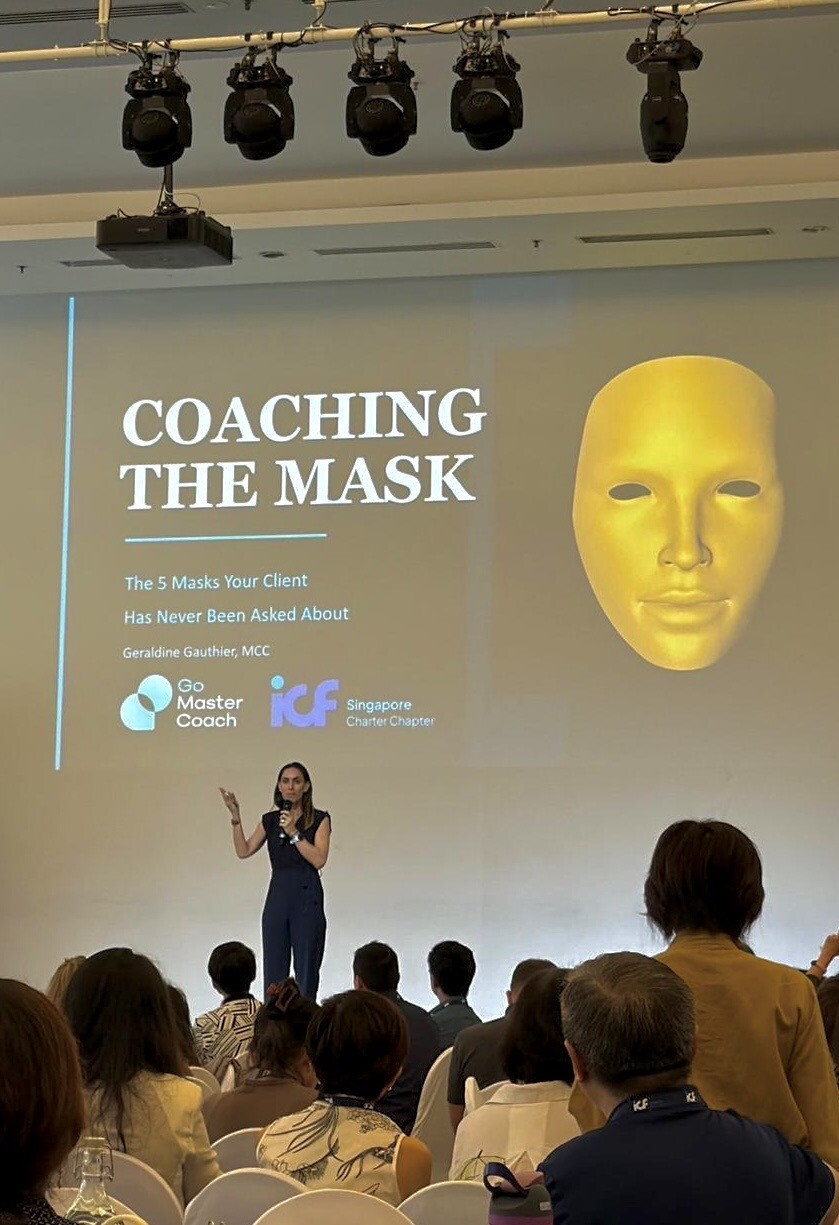
5-mask keynote at ICF International Coaching Week in Singapore.
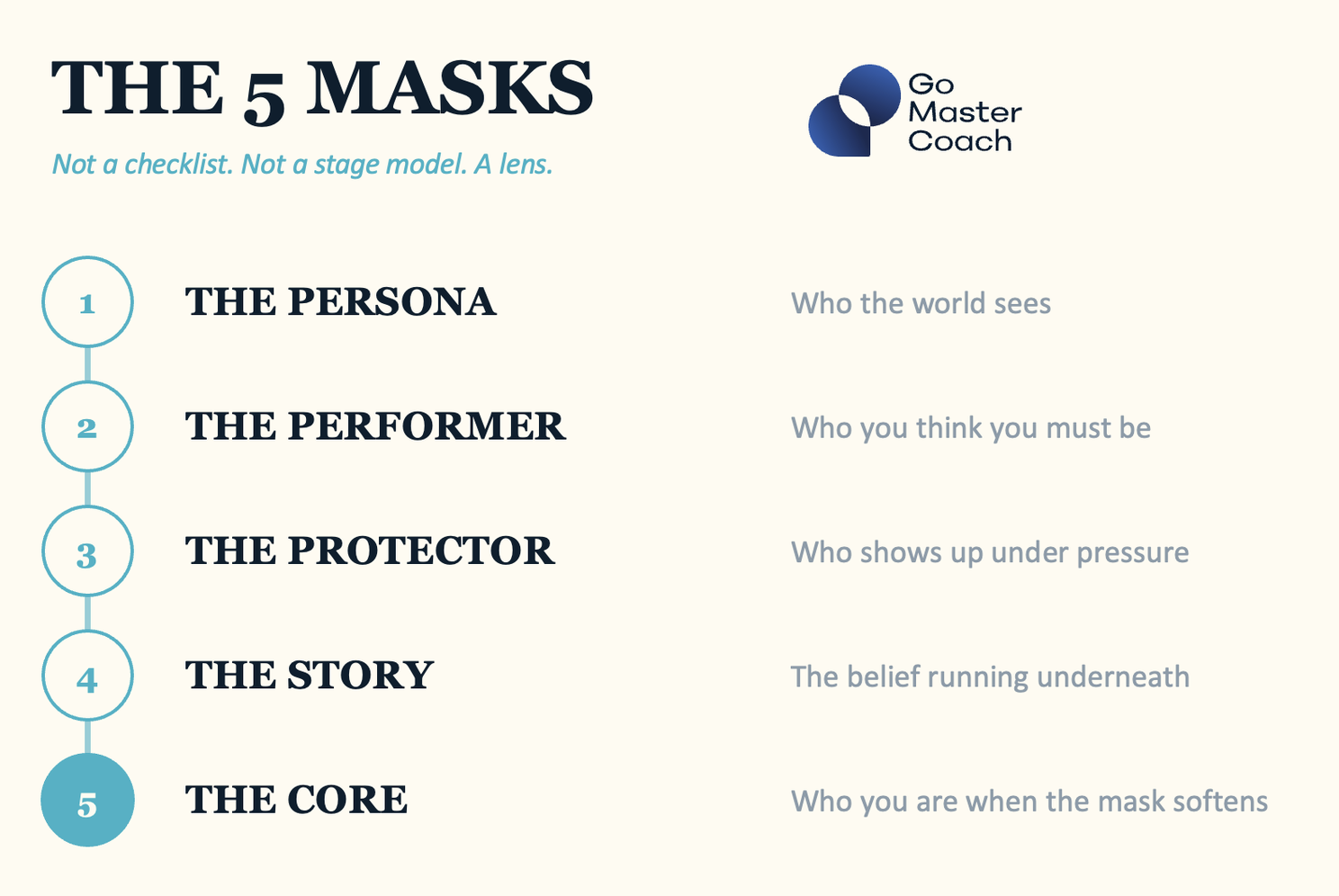
Now let's discover the 5-Mask Framework that I presented as a keynote at ICF International Coaching Week in Singapore
MASK 1 THE PERSONA
What the World Sees
What It Is
The Persona is the polished surface. The presenting narrative. The version of self that is socially acceptable, coherent, and safe.
The word persona comes from the Latin term for the masks worn by actors in antiquity. In Jungian psychology, the persona became the social face, the part that adapts to expectations, roles, and the need to belong. It is not bad. We all need one. We cannot expose our entire inner world in every meeting, every boardroom conversation, every LinkedIn post.
But in coaching, the Persona is where most sessions begin and where many sessions stay, without the coach realizing it.
How It Sounds
The Persona is highly objective. The language is manageable, structured, safe. It tells you what is happening, not what it costs, means, or feels like.
"The situation is…" / "My team is…" / "My goal is…" / "I'm fine." / "There's a lot going on, but it's exciting." / "I'm busy — but good."
Notice: facts without feeling. Narrative without vulnerability. The Persona gives you the PowerPoint version of someone's life. Polished. Well-organized. Minimal risk.
Real Example
Imagine asking: "How are things going?"
The Persona answers: "I'm scaling a coaching training platform across Singapore, Europe, and the US. We have active cohorts, a new accreditation file in progress, and I'm working on my 2027 vision"
All of that is true. It is also the version that can stand on stage without risk.What it does not yet say: the uncertainty underneath the move, the fatigue underneath the momentum, the question marks underneath the confidence.
That is the Persona. The presenting issue is real but it is the costume, not the person wearing it.
Every presenting issue is a costume
The Coaching Trap
COACHING TRAP Smart clients leaders, high achievers, people who are excellent at analysis, are exceptionally good at the Persona. They bring a polished story, and coaches become fascinated by the story. The whole session stays in problem-solving mode. The goal, the timeline, the strategy. And the actual person never enters the room. Solving the costume is not coaching the person.
How to Coach It
Do not challenge the Persona too early. It exists for a reason. Your job at this stage is to create clean, trustworthy contact. Clarify the situation, separate facts from interpretations, and start listening for what is underneath the structure.
Key Questions
— "What feels most important today — not most urgent, most important?"
— "What is the part you have not said yet?"
— "What would you like to get from this conversation?"
— "If I zoom out — what is actually going on for you?"
— "What is the real problem underneath the problem you just described?"
KEY INSIGHT The Persona is not the issue. The trap is staying there. Every presenting issue is a costume. The real work begins when you ask about the person wearing it. And remember: the strongest Persona is often called "I've got this."
MASK 2 THE PERFORMER
Who They Think They Must Be
What It Is
The Performer is where the mask tightens. It is the world of pressure, impossible standards, and identity rules. It appears when the client is no longer simply describing a situation — they are describing who they believe they must become in order to survive it.
This mask is extremely familiar to high achievers. Every role carries a potential performance contract. Every title adds a new layer of should.
How It Sounds
The language shift is immediate and diagnostic. Where the Persona is objective, the Performer is loaded with internal obligation.
"I should be better at this." / "I must be stronger." / "I cannot afford to fail." / "I need to be more credible." / "I should already know this." / "I cannot disappoint them." / "I have to hold it all together."
Listen for: should, must, need to, have to, can't afford to. These are not just words. They are the internal contract the client has signed with themselves usually years ago, rarely consciously.
Real Example
When I passed my MCC — Master Certified Coach — it was a genuine milestone.
But with the title came a new possible mask:
"MCC can mean credibility. It can also mean: you are MCC, you should know the answer."
"Founder can mean purpose. It can also mean: you built this, you should not show doubt."
The question is never whether the role is good or bad. The question is: when does the role become a performance contract?
The Coaching Trap
COACHING TRAP Many coaches try to coach confidence when they hear the Performer. They give tools, strategies, resources... more to carry. But the Performer does not need more strategies. The Performer needs the standard to become visible and to be questioned. If you give a Performer more to do, you reinforce the pressure.
How to Coach It
Slow down. Do not validate the standard automatically. Make the rule visible, without attacking it. The tone must stay curious, not confrontational. You are not saying: "You are performing." You are asking: "What are you trying so hard to carry?"
Key Questions
— "Who do you feel you have to be right now?"
— "When you say 'I should' — where does that come from?"
— "What standard are you holding yourself to?"
— "What would happen if you did not meet it?"
— "Who gave you this job description?"
— "What would become possible if you did not have to prove so much here?"
KEY INSIGHT Some clients do not need more confidence. They need permission to stop performing. The Performer mask never rests and no one can carry that forever.
This is one of the patterns we explore most deeply in our ICF ACC and PCC coach training programmes, because coaches who carry this mask themselves will collude with it in their clients.
MASK 3 THE PROTECTOR
Who Shows Up Under Pressure
What It Is
The Protector is the automatic response. The survival pattern. The nervous system strategy that activates when the system feels threatened, not physically, but socially, emotionally, or identity-wise.
This mask is most often the breakthrough layer and the one most frequently misread as a problem when it is actually a very intelligent solution. The nervous system is designed for survival, not authenticity. The Protector is its expression.
How It Sounds
"I just push through." / "I take control." / "I keep busy." / "I go quiet." / "I overprepare." / "I say yes." / "I become very rational." / "I cannot stop." / "I need to act now."
Some people control. Some people please. Some people withdraw. Some people over-intellectualize. Some people become hyper-competent. Some people become invisible. These are not random. They are intelligent adaptations.
Real Example
In the middle of a complex move, a business running across time zones, cohorts to support, new projects, challenges at home, my Protector does not say: "I am overwhelmed."
It says: "Let's make a plan. Let's move faster. Let's solve this. Let's organize everything. Let's stay useful."
From the outside, that looks like efficiency. Like leadership. Like having it together.
And it has helped me build and lead. The same strategy that made me successful can also disconnect me from what I actually feel.
Think of it this way: the Protector is like an emergency sprinkler system. Built for real fires. The problem is it sometimes activates for burnt toast in the break room and floods everything in the process.
The question is not whether the Protector is good or bad. The question is: is it still calibrated for the right situation?
The Coaching Trap
COACHING TRAP The most common error is challenging the Protector too fast. If you confront the behavior directly, you trigger more protection. Another trap: colluding with the Protector. A client comes in micromanaging everything, needing a rigid plan. The coach builds an even more detailed action plan with them. It feels productive but it just reinforced the Protector. You treated the symptom as the cure.
How to Coach It
Honor before you explore. This is not option it is structural. If the Protector does not feel respected, it will not open.
"Can we be grateful to this part of you for a moment before we explore whether it still needs to work so hard?"
This removes shame, creates safety, and allows the client to look at the pattern without becoming defensive about it.
The ICF Core Competencies speak directly to this — particularly Maintains Presence and Cultivates Trust and Safety. You cannot reach the Protector without both.
Key Questions
— "When pressure rises, what do you notice yourself doing automatically?"
— "What is that part of you trying to make sure of?"
— "What has this strategy helped you avoid?"
— "What has it helped you achieve?"
— "And what is it costing you now?"
— "If this part of you could speak, what would it say it is protecting?"
KEY INSIGHT The Protector is a survival strategy, not a character flaw. Coaching helps it become a choice rather than an automatic response. Honor it first. Always.
The mask is not the problem
MASK 4 THE STORY
The Belief Running Underneath
What It Is
The Story is the meaning-making layer. The narrative that silently shapes everything the client believes is possible, safe, or true. It is where the work becomes subtle because the Story sounds like fact.
It is not what happened. It is what the client decided their experience means about who they are. A conclusion formed through experience, repeated so many times it became identity.
How It Sounds
"That is just who I am." / "I have always been like this." / "I am not enough." / "I always have to prove myself." / "If I slow down, I will fall behind." / "If I am not useful, I do not matter." / "If I disappoint people, I will lose connection."
This is identity-level meaning. It is not only what the client does, it is what the client believes their behavior says about their worth.
Real Example
When you build something ambitious: a global platform, an international practice, a family across multiple countries, it is easy to carry invisible stories like:
"If I slow down, everything will fall apart."
"If I am not useful, I am not valuable."
"If I do not keep creating, I will lose momentum."
"If I disappoint people, I will lose connection."
From the outside, these look like drive, discipline, and ambition. They power results. But underneath, there is a quiet belief about worth that never quite rests.
A diagnostic I use: ask the client to complete: "I am only okay when I…"
Common answers: "…succeed." "…am useful." "…have approval." "…do not fail."
Whatever follows that sentence is likely the Story. And the old Story will use any new strategy to recreate the same pattern.
The Coaching Trap
COACHING TRAP The instinct when you hear a limiting Story is to challenge it to say "that is not true" or immediately offer a reframe. This almost always backfires. For the client, the Story does feel true. If you argue against it too fast, you push them into defensiveness and skip the pain underneath. When a client reveals their Story, the most powerful thing a coach can do is stay spacious. The space itself is the intervention.
How to Coach It
Do not debate the belief. Create space around it. Help the client see the Story as a story — not as immutable truth, and not as a prison.
— "What story about yourself might be running underneath this?"
— "Complete this sentence: 'I am only okay when I…'"
— "What does this story make possible for you? What does it make impossible?"
— "What is the cost of continuing to believe this?"
— "What might be a more generous version of this story?"
— "What would change if this were not the whole truth?"
KEY INSIGHT Clients do not bring us their truth first. They bring us what is safe. The Story is where the deepest safety work happens. We are not coaching a goal — we are coaching the identity from which the goal is being pursued.
MASK 5 THE CORE
Who They Are When the Armor Softens
What It Is
The Core is not really a mask. It is what becomes visible when the masks soften.
It is the aligned self. The values, the truth, the deeper presence. Not the role, not the performance, not the protection. The person underneath all of it, underneath the titles, the responsibilities, the urgency, and the noise.
The Core is not passive. It is not weak. It is often the most powerful presence in the conversation. But it does not shout, prove, or perform.
How It Sounds
"I actually want to lead with more courage." / "I want to be honest, really honest." / "I want to create, not just achieve." / "I want to be present, not only productive." / "I want to choose from love, not fear." / "I want to come back to what actually matters."
Notice what has shifted: less pressure, less proving, more truth, more values, more choice. The mask explains. The Core knows.
Real Example
Underneath all the roles, the founder, the MCC, the trainer, the mother, the person managing cohorts and logistics and vision, there is a part that is none of those things.
The part that wanted to create meaningful transformation before it had a title.
The part that loves learning for its own sake.
The part that believes coaching genuinely changes lives.
The part that wants to be present with the children, not only efficient for them.
The part that wants to build something powerful without losing herself in the building of it.
That is the Core. Not a new identity. Not a performance of authenticity.What is revealed when the other layers have been heard, respected, and gently set aside.
Reconnecting with the Core does not dissolve the Performer or the Protector. It simply returns the client to the author of their choices rather than the servant of their survival strategies.
The Coaching Trap
COACHING TRAP When a client touches the Core, coaches often stay abstract more questions, more space, but nothing lands. Or they rush to action excited by the breakthrough, moving immediately to planning. Both miss the same thing: insight without a behavioral anchor does not hold.
How to Coach It
The intervention at the Core is integration not more exploration. Help the client translate awareness into one grounded, real step. Not a transformation. Not a complete plan. One step that honors what just became visible.
Key Questions
— "When you are at your best — who are you being?"
— "What values want more space in this situation?"
— "What part of you feels most true right now?"
— "If you were fully aligned with yourself — what would you choose?"
— "What one small step would honor that version of you?"
— "What does that version of you need more of right now?"
KEY INSIGHT The goal is not to remove the mask. The goal is to make the environment safe enough for the client to no longer need to hold it so tightly. The Core does not need to win. It just needs room to speak.
Coaching mantra
The 5 Most Common Coaching Mistakes With Masks
1. Coaching the costume, not the person. Staying in problem-solving mode when a deeper identity layer is present. The client brings a goal; you coach the goal. But underneath the goal is a Performer, a Story, a Protector and those go untouched.
2. Forcing intimacy too fast. Skipping the Persona and pushing for depth before the client feels safe. You cannot excavate what has not been invited. Depth requires safety. Safety requires time.
3. Colluding with the mask. A client in Protector mode presents with hyper-control and a need for a detailed plan. The coach responds by building an exhaustive action plan together. It feels like progress but it reinforces the protection instead of gently exploring what it is protecting.
4. Debating the Story. Challenging a client's belief directly before they feel safe enough to question it themselves. When you argue with the Story, the client defends the Story. Stay spacious. Create room around the belief not against it.
5. Leaving the Core abstract. Reaching a moment of genuine alignment and not anchoring it in behavior. When a client touches the Core, the work is not over, it has just reached its most important point. One grounded step closes the gap between insight and integration.
Applying the Framework: Which Mask Is Speaking Right Now?
You do not move through all five masks in sequence in every session. The question is always: which mask is my client speaking from right now?
This is a skill that deepens with practice — and with supervision. At GoMasterCoach, our coaching supervision and mentor coaching are designed to help coaches develop exactly this kind of perceptual range.
5-mask matrix
Coaching Begins Where Performance Ends
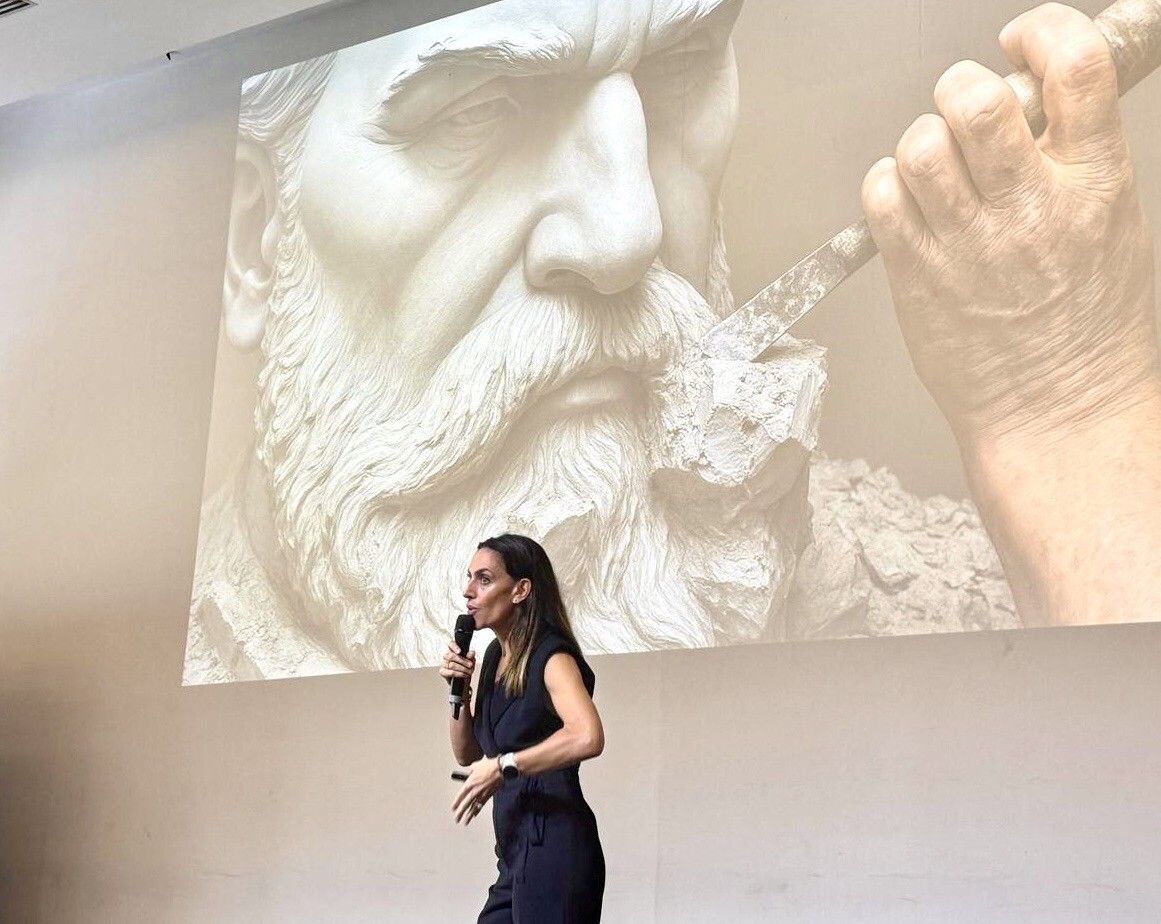
Coaching does not consist of adding more. It is often the opposite. It is like sculpting. We do not add. We remove the noise, the unnecessary pressure, the inherited rules, the performance that is no longer needed until the client can hear their own voice again.
"Coaching is like sculpting" Geraldine GAUTHIER at keynote at ICF International Coaching Week.
There is an image I return to. A client walking around in a thick, heavy coat in the middle of July. Not because the coat is wrong. Not because they are weak. Simply because they forgot they have the power to take it off.
Our job is not to rip the coat away. Our job is to create the kind of space where the client remembers, gently, safely that wearing it was always a choice.
We wear masks to belong. We loosen them to become.
The most powerful coaching does not remove the mask by force. It creates the kind of safety where, little by little, the client no longer needs to hold it so tightly.
And what becomes visible underneath is not a new person. It is the person who was always there waiting for the room to be safe enough to speak.
About the Author
Géraldine Gauthier, MCC is a Master Certified Coach and the Founder of GoMasterCoach, a global coaching training platform operating across Singapore, Europe, and the US. She has delivered over 3,000 coaching hours across leadership, organisational, and executive contexts, and trains coaches toward ICF ACC and PCC certification. The 5-Mask Framework was presented as a keynote at ICF International Coaching Week with the Singapore Chapter of the International Coaching Federation.
Want to Go Deeper Into This Framework?
Check out a free masterclass to learn more about how GoMasterCoach supports your journey to ICF certification — and how frameworks like this are woven into every programme we offer.

.svg)

.svg)
.webp)


.webp)





.jpg)