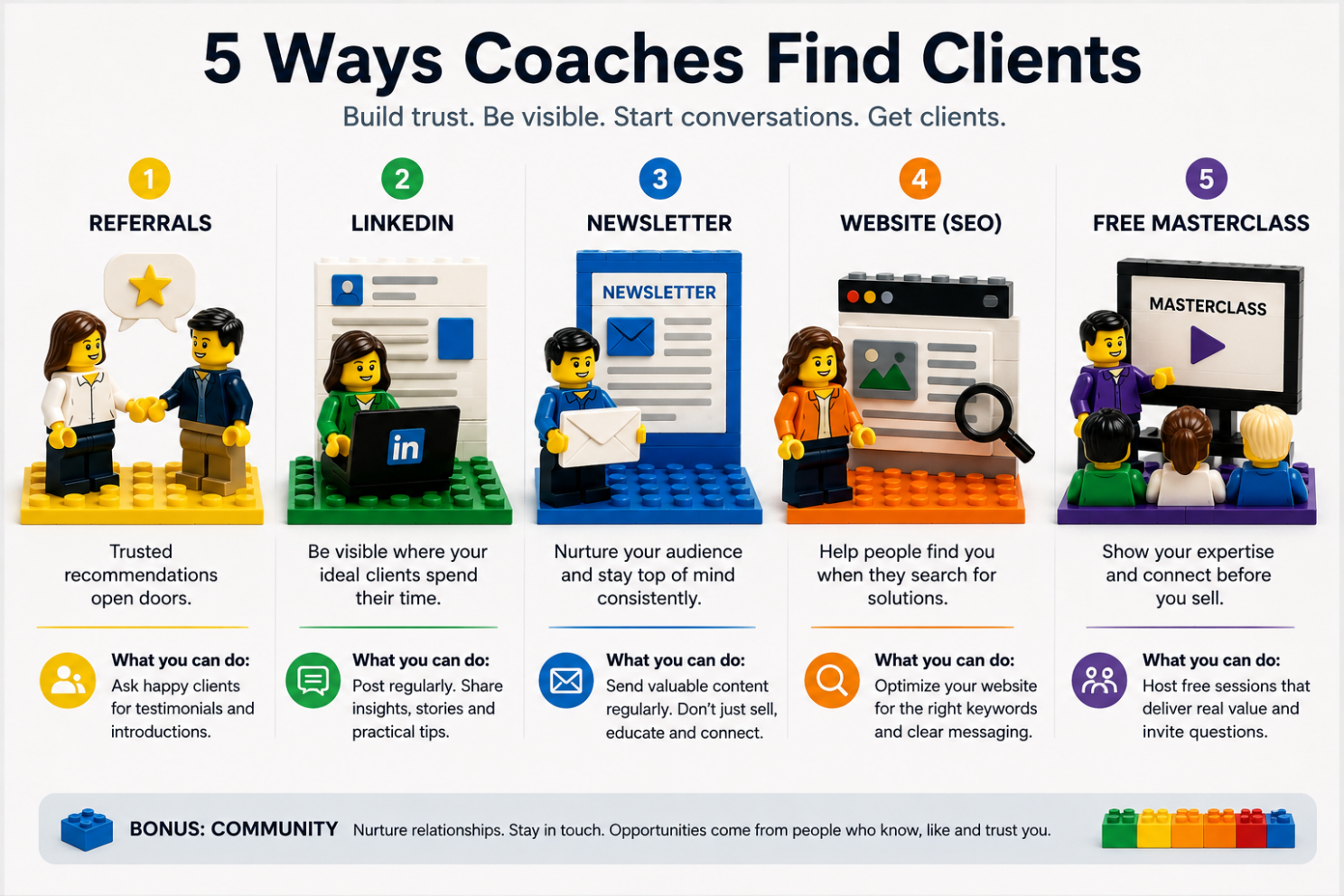
5 practical channels that actually work, especially when you are starting.
A peer asked me yesterday: “How do you find your clients?”
I get this question all the time from coaches, consultants and solopreneurs. And I think many people are secretly hoping for one magic answer.
The perfect funnel. The perfect platform. The perfect post. The perfect offer. But in my experience, clients usually come from something much simpler:
Trust, repeated consistently.
After years of coaching, training coaches and building GoMasterCoach, here are the 5 channels that have worked best for me.
More importantly, here is what you can actually do with each one, even if you are just starting.
1. Referrals
Referrals are still the most powerful channel. Not because they are sophisticated. Because they are trusted.
Many of my clients come through former clients, alumni, partners, peers, or people who have experienced our coaching certification programmes.
But referrals do not happen only because people like you.
They happen when people clearly understand:
what you do
who you help
what problem you solve
who they should send your way
If people cannot explain your work in one sentence, they will struggle to refer you.
What to do this week: Send a simple message to 10 people who already trust you.
Example:
“Hi X, I’m currently opening a few coaching spots for people who want to [specific outcome]. If someone comes to mind, I’d be very grateful if you could connect us.”
Or:
“I’m collecting a few short testimonials from people who have experienced my work. Would you be open to sharing 2 or 3 lines about what shifted for you?”
This is not pushy. This is making it easy for people to support you. Do not wait for referrals.
Create the conditions for referrals to happen.
2. LinkedIn
LinkedIn has been unbelievably powerful for me. Not because I post perfect content. Because I show up consistently enough for people to understand what I stand for. The biggest mistake I see many coaches make is posting content that is too vague.
Beautiful reflections. Inspirational quotes. Big ideas about transformation.
Nice, yes.
But not always useful for a future client. If you want clients, your content needs to help people recognise themselves.
Post about:
the problems your clients bring to you
the real problem underneath
the mistakes you see again and again
the questions you ask in coaching
the small shifts that create big change
stories from your practice, anonymised of course
For example, instead of writing: “Self-awareness is important in leadership.”
You could write: “Most leaders I coach do not have a time management problem. They have a boundary problem. They say yes too fast, protect everyone else’s priorities, and call it commitment.”
That is more specific. And specific is what creates trust.
What to do this week:
Write 3 posts using this simple structure:
People think the problem is X. But often, the real problem is Y. Here is what I see. Here is one thing you can try.
Example: People think they need more confidence to start coaching. But often, they need more conversations. Confidence does not come before action. It comes from action. This week, speak to 5 people about the kind of coaching you want to offer.
And when people comment, do not just say “thank you”.
Start a real conversation. That is often where clients begin.
3. Newsletter
Our newsletter now has over 20,000 subscribers. But it did not start there.
It started with a small group of people who wanted to learn more about coaching, leadership and personal growth.
A newsletter is powerful because it helps you stay close to people who already know your voice. You are not depending only on the algorithm. You are building a relationship over time. Your newsletter does not need to be complicated. You can send:
one useful coaching question
one client pattern you noticed
one story from your practice
one simple tool
one invitation
Example:
“This week, I noticed how many clients confuse being available with being valuable. They answer too fast. They rescue too much. They protect everyone else’s priorities.
A question to reflect on: "Where are you over-helping?” Then, at the end, you can add:
“If you are exploring coaching or certification, reply to this message and I’ll send you more information.”
Simple. Useful. Human.
What to do this week:
Start with 20 people. Not 20,000. Former colleagues. Friends. Past clients. People who attended a workshop. People who once asked you about coaching.
Send one useful message every two weeks.
Consistency beats sophistication.
4. Website & AEO
A website is not just a digital brochure.
It should answer the questions your future clients are already asking. When we worked on our website and AEO / SEO, it started generating leads from people searching for coaching certification, ICF training, coaching programmes and coaching support.
SEO/AEO still feels slightly mysterious to me.
And yes, I may now receive 47 emails from AEO / SEO agencies for admitting this.
But here is what I have learned:
Your website should not only say:
“I am passionate about transformation.”
It should answer:
Who is this for? What problem do you solve? What result can I expect? How does it work? What is included? How much does it cost? Why should I trust you? What is the next step?
What to do this week:
Create one simple page with this structure: I help [type of person] with [specific problem] so they can [specific result] through [your offer].
Example:
“I help new managers stop feeling overwhelmed and start leading with clarity, confidence and better boundaries through 1:1 coaching.”
Or:
“I help aspiring coaches become certified and build strong coaching foundations through ICF-accredited training.”
And please, make the next step obvious. Book a call. Join a masterclass. Download a guide. Send a message. People should not need to become detectives to work with you.
5. Free masterclasses
Free masterclasses have been one of the best ways for people to experience our style before joining a programme.
Because coaching is relational.
People want to feel:
how you speak
how you think
how safe the space is
how practical your method is
whether they trust you
But a masterclass should not be a 60-minute sales pitch. It should give real value.
Examples of simple masterclass topics:
For a leadership coach: “3 mistakes new managers make when they try to delegate”
For a career coach: “How to make a career decision when everything feels unclear”
For a parenting coach: “How to stay calm when your child triggers you”
For a coach trainer: “What coaching is, what it is not, and how to know if certification is right for you”
What to do this week:
Choose one specific problem your audience has.
Create a 45-minute session: 10 minutes: the problem 20 minutes: 3 practical insights 10 minutes: one exercise or reflection 5 minutes: invitation to go further
Then invite people personally. Not with a mass message. A real one.
Example: “Hi X, I’m running a free session on [topic]. I thought of you because [reason]. No pressure of course, but I’d be happy to have you there.”
At the end of the session, make a clear invitation. Not pushy. Just clear.
“If you want to go further, here are the next ways to work with me.”
Clarity is not salesy. Confusion is costly
5 Ways Coaches Find Clients
And the 6th channel?
Community.
The best business development strategy is not always to chase strangers. Sometimes it is to nurture the people already around you. Your alumni. Your former clients. Your peers. Your partners. Your former colleagues. Your supporters.
Stay in touch. Share useful things. Celebrate their wins. Connect people. Be generous. Be visible.
Especially when you are starting, your first clients are usually not “out there”. They are often one conversation away.
So here is my challenge for you this week:
Send 5 messages.
Write 1 useful post.
Invite people to 1 conversation.
Ask for 1 testimonial.
Make your offer clearer.
You do not need a huge audience to get your first clients. You need clarity, consistency and courage.
What would you add as number 7?
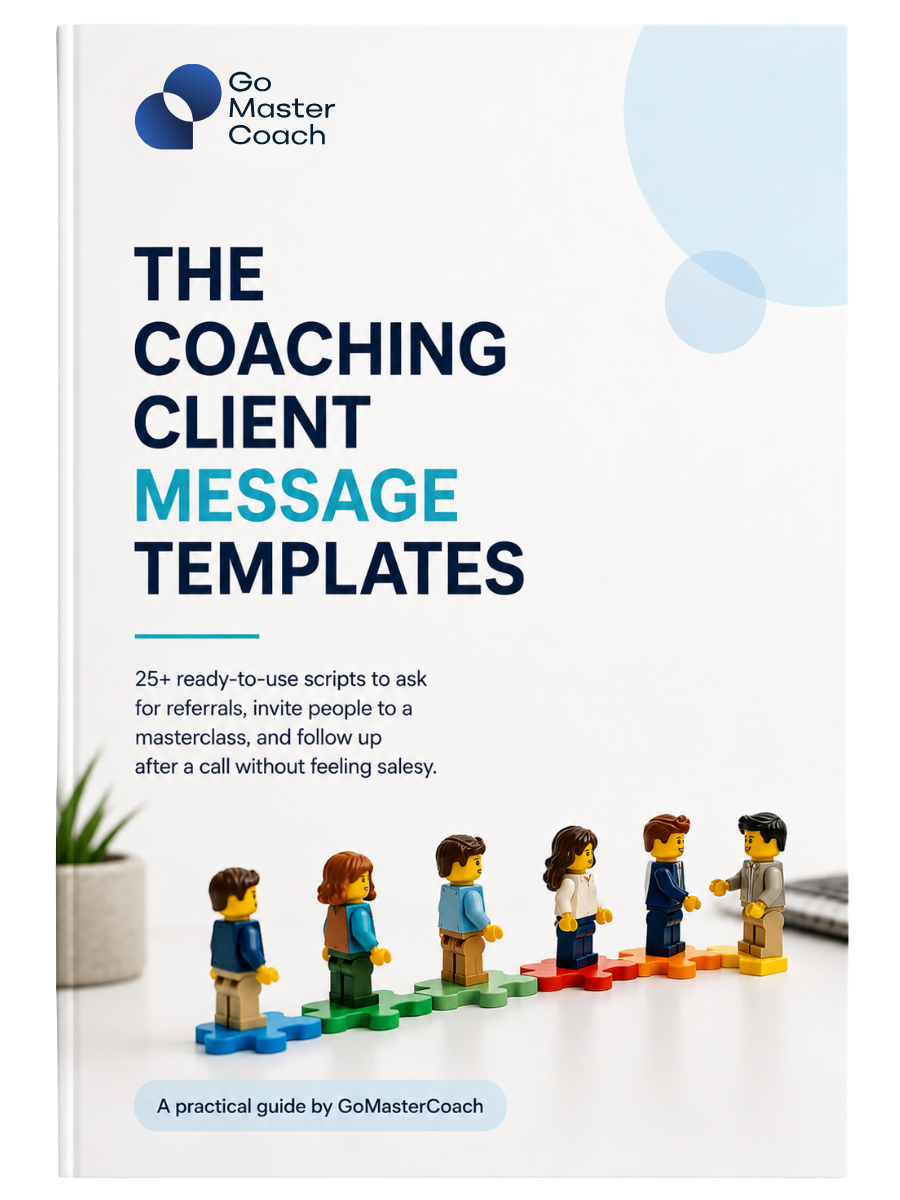
If useful, I can also share the exact message templates I use to ask for referrals, invite people to a masterclass and follow up after a call. Comment “messages” and I’ll send them.
Not sure what to say when reaching out?
One of the questions I hear most often from coaches is: “What do I actually say to potential clients?”
I know how easy it is to overthink that first message. You don’t want to sound pushy, salesy, or like you’re trying to convince someone to become a client.
That’s why I put together these Coaching Client Message Templates with practical examples you can adapt when finding coaching clients, asking for referrals, reconnecting with your network, or following up with potential clients.
Géraldine Gauthier, MCC is a Master Certified Coach and the Founder of GoMasterCoach, a global coaching training platform operating across Singapore, Europe, and the US. She has delivered over 3,000 coaching hours across leadership, organisational, and executive contexts, and trains coaches toward ICF ACC and PCC certification.
Want to Go Deeper Into This Framework?
Check out a Free Info Session to learn more about how GoMasterCoach supports your journey to ICF certification - and how business strategies like this are incorporated into every programme we offer.

.svg)

.svg)
.webp)


.webp)




.jpg)