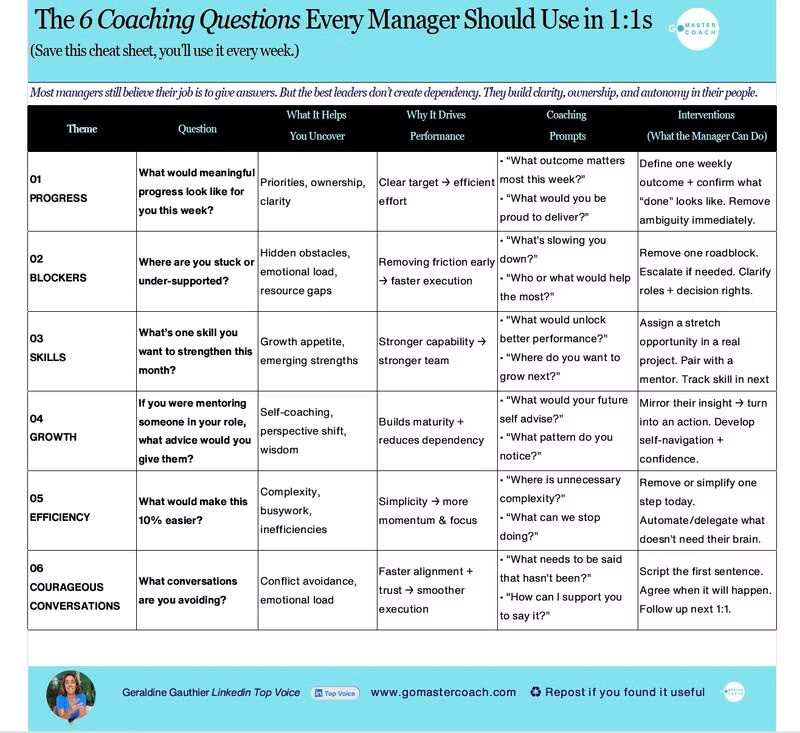
The 6 Coaching Questions Every Manager Should Use in 1:1s
Géraldine Gauthier
19 Dec 25
|
3 min read
|
(A practical guide for managers who want better conversations, stronger ownership, and real growth.)
One of the biggest misconceptions about management is that you need to have all the answers.
Early in my career, while working in finance, my team came to me constantly:
“Can you review this?”
“Is this the right approach?”
“What do you think I should do?”
At first, it felt good. I felt helpful, trusted, and competent.
But over time, I realised something uncomfortable: I wasn’t developing my team. I was training them to rely on me.
I was exhausted. And they were stuck.
That realisation led me to change how I showed up in 1:1 meetings.
Instead of jumping in with solutions, I started asking coaching questions: the kind that help people think, decide, and take ownership for themselves.
The impact was immediate and lasting. People became more confident, more accountable, and more proactive. And I stopped being the bottleneck.
After managing teams and coaching leaders across London, Singapore, Paris, and Hong Kong, these are the six coaching questions I consistently see transform 1:1 conversations.
Why Coaching Questions Matter in 1:1 Meetings
Effective 1:1s aren’t about status updates or problem‑solving on behalf of your team.
They’re about:
Building critical thinking
Encouraging ownership and accountability
Developing leadership capability
Creating psychological safety
Coaching-style questions shift the conversation from “Tell me what to do” to “Let me think this through.”
The 6 Coaching Questions Every Manager Should Use
1. What would meaningful progress look like this week?
This question shifts the focus from being busy to making progress.
It helps your team member clarify priorities, define success in their own words, and commit to concrete outcomes, without you setting the agenda for them.
Use it when: conversations feel vague or stuck at a high level.
2. Where are you stuck or under-supported?
Instead of asking, “Do you need help?” which often gets a polite “no,” this question normalises challenges and invites honesty.
It also helps you distinguish between where someone needs guidance versus space.
Use it when: you sense frustration, delay, or disengagement.
3. Which skill do you want to level up this month?
This reframes professional development as ongoing and self-directed, rather than something tied only to performance reviews.
It encourages your team member to take ownership of their growth, and signals that learning matters.
Use it when: you want to build long-term capability, not just short-term results.
4. If you were mentoring someone in your role, what advice would you give them?
This question creates distance from the problem and activates deeper insight.
People often know more than they think. This helps them access their own wisdom and see options they hadn’t considered.
Use it when: someone feels unsure or is second-guessing themselves.
5. What would make this 10% easier?
Rather than aiming for a perfect solution, this question focuses on momentum.
A 10% improvement feels achievable and reduces overwhelm, while still moving things forward.
Use it when: tasks feel heavy, complex, or emotionally loaded.
6. What conversation are you avoiding?
This is often the most powerful, and uncomfortable, question.
Avoided conversations usually sit at the root of stalled progress, team tension, or personal stress. Naming them is the first step toward action.
Use it when: issues keep resurfacing without resolution.
How to Use These Questions Effectively
A few important reminders:
You don’t need to ask all six in one meeting.
Silence is part of the process: give people time to think.
Your role is to listen, not to rescue.
When managers consistently use coaching questions, 1:1s become a space for clarity, ownership, and growth, not dependency.
Bonus: Podcasts can be a great way to sharpen your communication skills as a leader. I’ve put together a list of my top 10 podcasts on coaching and leadership if you’d like to explore further.
If you want stronger 1:1s, start by asking better questions, and resist the urge to provide the answer.
📄 You can find a printable cheat sheet of these six coaching questions in the image above. Save it for your next 1:1, or share it with a manager who wants to grow.
If asking better questions is something you want to do more consistently, as a manager, leader, or internal coach, learning with structure and support makes a real difference real difference.