The ICF PCC and MCC Credentialing Exam Is Changing in 2026: What Coaches Need to Know
Géraldine Gauthier
15 Sep 26
|
7 minutes
|
I went through the journey to MCC myself.
I know how heavy the assessment side can feel.
So our job at GoMasterCoach is simple:
Make the standards easy to understand. Easy to practice. Easy to apply.
And with the ICF Credentialing Exam changing, we want to make the changes easier to navigate too.
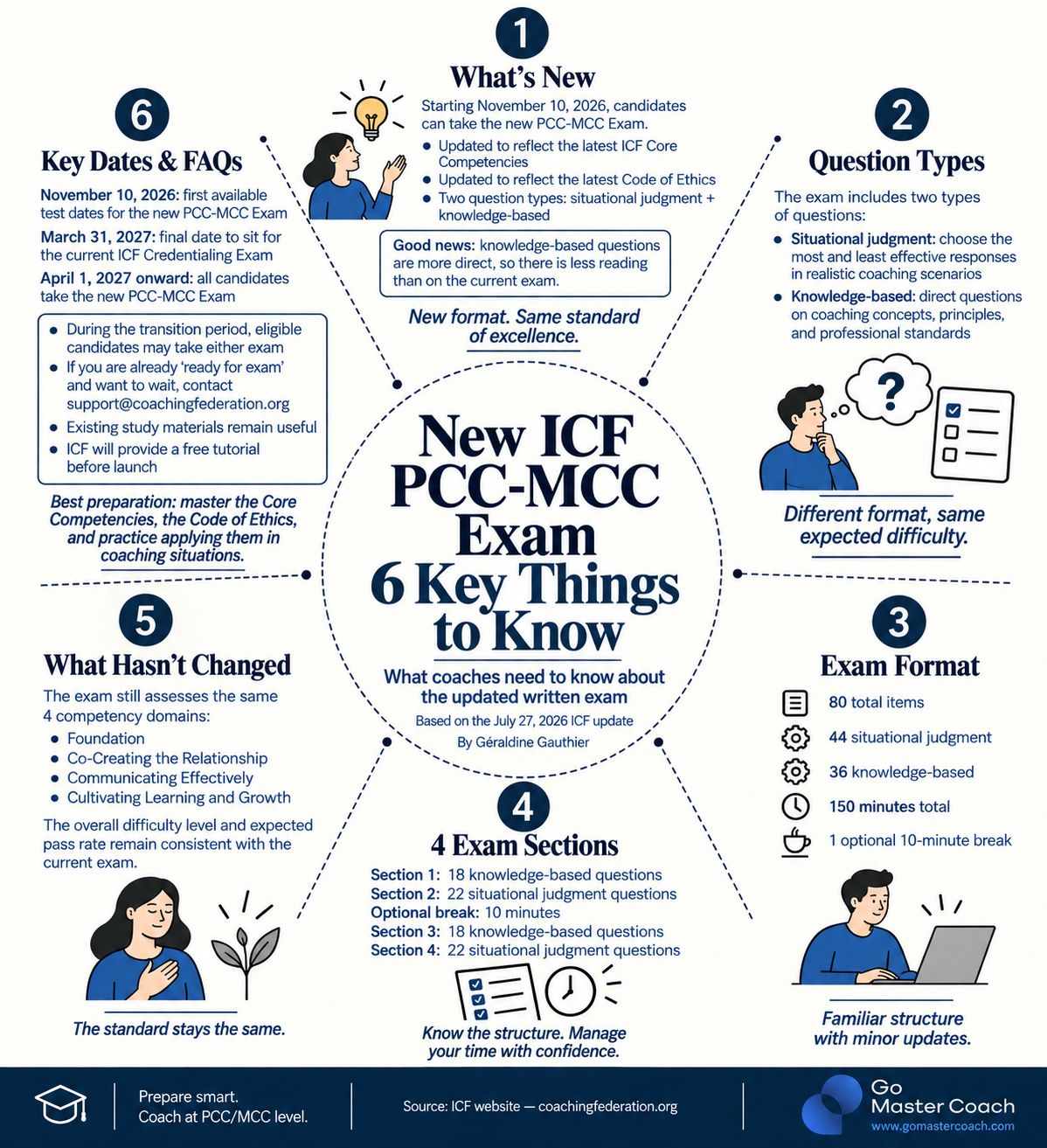
Here are the key changes at a glance:
If you’re working toward your ICF PCC or MCC credential, these changes are relevant to you. The International Coaching Federation (ICF) will introduce the new PCC-MCC Exam on November 10, 2026.
Naturally, the first question many coaches are asking is:
“Is the new ICF exam going to be harder?”
The short answer is: no.
The new exam will include both situational judgment questions and knowledge-based questions, but ICF has stated that the overall difficulty level and expected pass rate will remain consistent with the current exam.
If you are preparing for your PCC or MCC, here is what is changing, what is staying the same, and how you can prepare with confidence.
What is changing in the ICF PCC-MCC Exam?
The biggest change is the format of the questions.
The current ICF Credentialing Exam is built around coaching scenarios. Candidates read a situation and select the most effective and least effective responses.
The new PCC-MCC Exam will use 2 types of questions:
1. Situational judgment questions
These continue to test your ability to apply coaching principles in realistic coaching situations.
You will still need to think like a coach rather than simply recall definitions.
For example, instead of asking you to identify a definition of a coaching competency, a question may present you with a conversation between a coach and client and ask you to determine which response best demonstrates effective coaching.
2. Knowledge-based questions
The new exam will also include more direct questions that assess your knowledge of coaching concepts, principles and professional standards.
This means that exam preparation will need to cover both:
What do you know?
and
How would you apply it in a coaching situation?
According to ICF, the knowledge-based questions are more direct and therefore require less time spent reading than the scenario-based questions.
But this does not mean the exam is becoming easier.
ICF has specifically stated that the overall difficulty level and expected pass rate will remain consistent with the current exam.
The new exam has been designed to maintain the same standard of coaching excellence. ICF has stated that the difficulty level and expected pass rate will remain consistent with the current exam.
What is changing is how your knowledge is assessed.
And that distinction matters.
A different exam format does not necessarily require you to learn a completely different body of knowledge.
The real preparation remains the same at its core: understand the ICF standards deeply enough that you can recognize and apply them in real coaching situations.
The 2025 ICF Core Competencies and Code of Ethics matter
There is another important point for coaches preparing for the new exam.
This means that preparation should not rely solely on older exam-preparation materials.
Take the time to understand the current standards, particularly areas that have received greater emphasis in the updated framework.
For example, coaches should be comfortable with concepts such as:
Maintaining an ethical coaching practice
Establishing and maintaining agreements
Demonstrating a coaching mindset
Creating a safe and supportive environment
Listening and communicating effectively
Supporting client autonomy and learning
Understanding the appropriate use and disclosure of AI
Maintaining clear role transparency
The goal is not to memorize new terminology.
It is to understand what these principles actually look like in practice.
So how should you prepare for the new ICF exam?
This is where we recommend going back to the fundamentals.
In our earlier article, 8 Steps to Master the ICF Credentialing Exam, we shared a preparation approach based on our experience supporting coaches through the ICF credentialing process.
The most important principle still applies:
Don't prepare only for the exam. Prepare to think like an ICF coach.
That means reading the Core Competencies and Code of Ethics, studying the minimum skills requirements, practicing with scenarios, and developing the ability to distinguish between a response that sounds helpful and one that is genuinely coaching-oriented.
And there is one simple framework that can help.
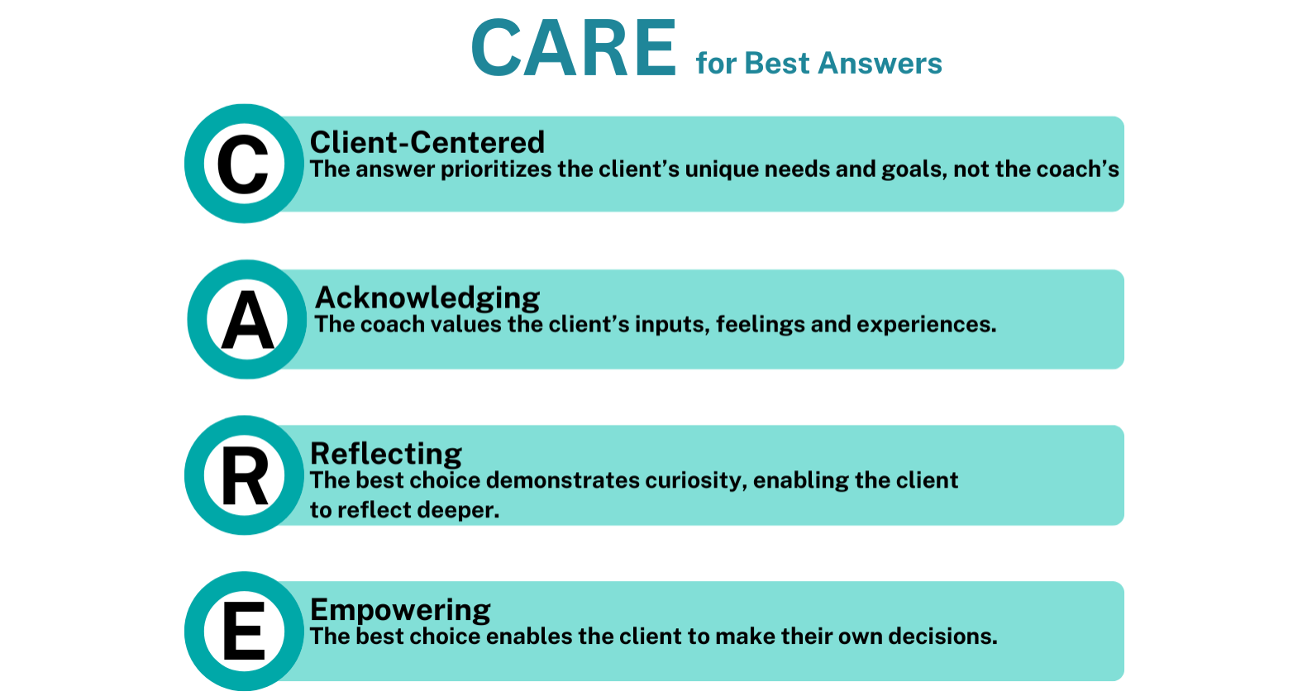
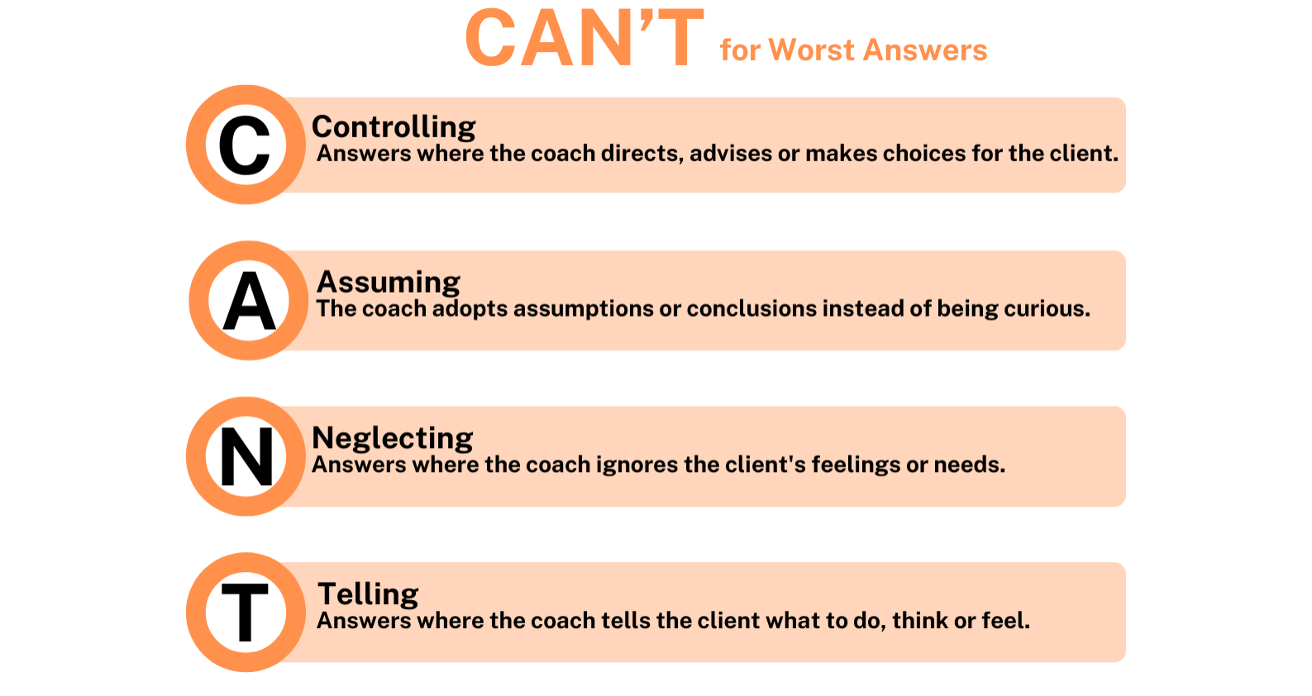
Use the CARE vs CAN'T framework
When you are faced with a coaching scenario, especially one where several answers appear reasonable, ask yourself:
Which answer demonstrates CARE?
and
Which answer falls into CAN'T?
CARE: What strong coaching responses tend to do
C: Client-centered
The response keeps the client's needs, perspective, goals and agenda at the center.
Ask yourself:
Is the coach following the client, or is the coach pushing their own agenda?
A: Acknowledging
The coach recognizes what the client is saying, feeling, experiencing or bringing into the conversation.
Ask:
Does the response genuinely acknowledge the client's experience?
R: Reflecting
The coach creates space for the client to explore, think and gain awareness rather than immediately providing an answer.
Ask:
Does this response invite deeper reflection?
E: Empowering
The coach supports the client in making their own choices and taking ownership of their next steps.
Ask:
Does the client remain the decision-maker?
These four qualities can be a useful mental shortcut when several answers seem “good.”
And then there is CAN'T
When looking for the least effective response, watch for answers that move away from the coaching mindset.
C: Controlling
The coach directs the client, takes over the conversation or decides what the client should do.
A: Assuming
The coach makes assumptions about what the client means, needs or feels instead of remaining curious.
N: Neglecting
The coach overlooks something important that the client has expressed.
T: Telling
The coach tells the client what to think, feel or do rather than supporting the client's own thinking.
Of course, CARE and CAN'T are not a replacement for knowing the ICF Core Competencies or Code of Ethics.
Think of them as a decision-making lens.
When you are unsure between two answers, they can help you step back and ask:
Which response is more client-centered, curious and empowering?
And:
Which response takes control, makes assumptions, overlooks the client or tells them what to do?
That shift in perspective can make a significant difference when working through exam scenarios.
The new exam still tests coaching judgment
It is easy to look at an exam change and immediately start searching for new study guides, new mock questions and new memorization techniques.
But the most valuable preparation is not memorizing more.
It is developing better judgment.
A strong coach should be able to look at a coaching conversation and recognize:
What is happening for the client?
What does the client actually need from this moment?
Is the coach following the client's agenda?
Is the coach making assumptions?
Is the coach giving advice when curiosity would be more appropriate?
Is the client being supported to generate their own awareness?
Is the coach maintaining appropriate ethical and professional boundaries?
These are not simply exam skills.
They are coaching skills.
And that is why preparing well for the ICF exam can also make you a better coach.
What if I am already preparing for the current exam?
Don't panic.
If your timeline allows you to take the current exam before March 31, 2027, you can continue preparing for it.
If you will take the new PCC-MCC Exam, your preparation should shift toward understanding both the knowledge and application sides of the assessment.
Either way, your foundation remains the same:
Know the ICF Core Competencies.
Know the Code of Ethics.
Understand what effective coaching looks like.
Practice applying those standards to real situations.
The exam format may change, but the standard of coaching excellence does not.
The best preparation hasn't changed
At GoMasterCoach, we believe the best way to prepare for an ICF credentialing exam is not to learn how to “beat” the test.
It is to understand the standards deeply enough that you can apply them naturally in real coaching conversations.
That is also why we design our coach training programs around developing coaching capability, not simply completing training hours.
If you are just beginning your coaching journey, our Foundations of Coaching Practice offers a practical introduction to professional coaching and the ICF Core Competencies. It can be a starting point for those who want to experience coach training before deciding whether to continue toward an ICF credential.
If you already know that you want to pursue the ICF ACC credential, our ACC pathway takes you through the training, mentor coaching, performance evaluation and practice coaching needed to prepare for the credentialing journey, with continued resources and support beyond the training itself.
And for coaches progressing toward PCC or MCC, our programs and exam preparation support can help you deepen your understanding of the ICF standards and develop the judgment needed to approach the credentialing exam with confidence.
In other words, the exam is only one part of the journey.
The real goal is becoming the kind of coach who can consistently demonstrate the competencies in practice.
Not sure where to start?
If you're researching coach training or the ICF credentialing pathway, you may still have questions:
Should I start with ACC? What does an ICF-accredited pathway involve? How much mentor coaching do I need? Should I start now or wait for the new exam? And which training program is right for me?
The session is designed for anyone considering professional coach training or an ICF credential and gives you an overview of the credentialing pathway, what to expect from coach training, and how our different programs fit into that journey.
It's also a chance to ask questions and get a clearer picture of your options before making a decision.
Géraldine Gauthier, MCC is a Master Certified Coach and the Founder of GoMasterCoach, a global coaching training platform operating across Singapore, Europe, and the US. She has delivered over 3,000 coaching hours across leadership, organisational, and executive contexts, and trains coaches toward ICF ACC and PCC certification.

.svg)

.svg)
.webp)


.webp)




.jpg)