7 Signs of a Good Coach (From an MCC Who Trains Them)
Géraldine Gauthier
08 Oct 26
|
8 minutes
|
A good coach is easiest to spot by what they don't do.
They don't fill silences.
They don't stack questions.
They don't rush to advice.
Instead they listen for beliefs and patterns, challenge without needing to be right, and stay focused on the client's answer, not their own performance. I call these the 7 Giveaways.
I can usually tell within 10 minutes whether someone has been trained as a coach.
Not because they ask better questions.
Because of what they don't do.
I've trained more than 1650 coaches and listened to hundreds of recorded sessions. Untrained coaches talk more. They help faster. They try harder.
Trained coaches do less. And their clients go further.
This applies whether you're a leadership coach, a manager who coaches your team, or someone wondering if coaching is your next career.
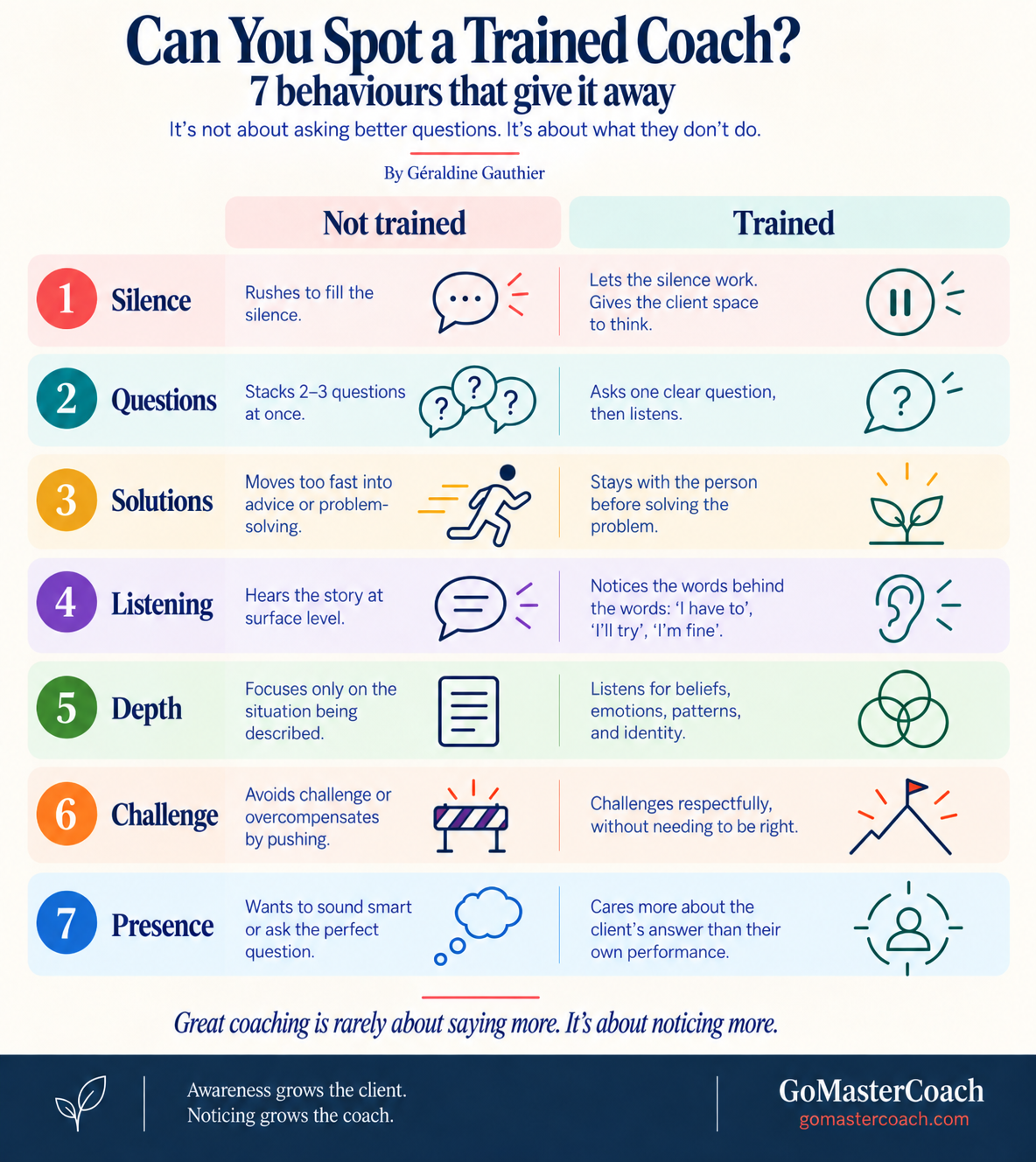
The 7 Giveaways at a glance
1. They let the silence work
A trainee of ours, a senior HR director with 20 years of experience, asked her client a strong question during an assessed session. The client went quiet. Three seconds. Four.
She jumped in. "Or, maybe what I mean is..."
We replayed the recording together. You could hear the client breathe in, about to answer. The answer never came.
Silence feels like failure to a new coach. To the client, it's thinking time.
The research backs this up. Mary Budd Rowe found that teachers wait about one second after asking a question. When they waited around three seconds, answers grew 300% to 700% longer and "I don't know" replies dropped (Rowe, 1986). The ICF lists "creates or allows space for silence, pause or reflection" as part of Maintains Presence (ICF Core Competencies, 2025).
My rule for trainees: ask, then count to five in your head. The client speaks first.
2. They ask one question. Then they stop.
"What do you want? Is it the promotion, or more balance? And what's stopping you?"
Three questions. The client picks the easiest one. Usually the least useful.
In our mentor coaching, this is the marker we flag most often in first recorded sessions. Smart people do it most. They see three angles and want to offer all of them.
The ICF is precise here. PCC Marker 7.6: the coach "asks clear, direct, primarily open-ended questions, one at a time, at a pace that allows for thinking, feeling or reflection by the client" (ICF PCC Markers).
A quick test: If your question contains "or", you're probably asking two.
3. They stay with the person before the problem
When I started coaching, I coached like the finance professional I'd been. Spot the problem. Build the model. Fix it fast.
My clients left with good answers. Not their answers. So nothing changed.
Advice solves the problem the client named. It's rarely the real one. Michael Bungay Stanier calls the urge to fix "the Advice Monster" (The Advice Trap, 2020).
A trained coach asks first: who is this person in this situation? What's at stake for them?
A client once told me "I'm fine" four times in ten minutes. On the fourth, I said: "That's the fourth 'fine'." She laughed. Then she told me what was actually going on.
Small words carry big beliefs:
The client says
A trained coach hears
One possible question
“I have to.”
An obligation, maybe not a choice
“What happens if you don't?”
“I'll try.”
A way out, already built in
“What would ‘done’ look like?”
“I don't know.”
Often a door, rarely a wall
“And if you did know?”
“I'm fine.”
A door closing
“Fine on a scale of 1 to 10?”
The ICF defines active listening as focusing on "what the client is and is not saying" (ICF, 2025). In NLP, Richard Bandler and linguist John Grinder mapped these patterns in the Meta Model. "Have to" is a modal operator of necessity (The Structure of Magic, 1975).
5. They coach the person, not the situation
The difficult boss. The job offer. The deadline.
Untrained coaches work on these. Next week there's a new boss, a new offer, a new deadline. Same client. Same pattern.
Trained coaches listen underneath: beliefs, emotions, patterns, identity. PCC Marker 7.1 asks the coach to explore the client's "way of thinking, feeling, values, needs, wants, beliefs or behavior" (ICF PCC Markers).
At GoMasterCoach we call this coaching below the surface. Our Coaching the Mask framework maps the five layers a client shows you, from the polished Persona down to the Core.
One question I use constantly: "What does this say about you?"
6. They challenge, then let go
Most new coaches are too nice. A few are too pushy. Both are about the coach, not the client.
The nice ones want to be liked. The pushy ones want to be right.
A trained coach challenges and then drops the outcome. The ICF puts "challenges the client as a way to evoke awareness or insight" inside Evokes Awareness (ICF, 2025). The challenge only lands if trust is already there.
The simplest way to do it: offer an observation, not a verdict. "You've said 'later' three times. What do you make of that?"
7. They care more about the answer than the question
This is the biggest giveaway.
Beginner coaches search for the perfect question.
Experienced coaches are far more interested in the client's answer.
In our trainees' first recorded sessions, the coach talks around half the time. By their final assessment, it's closer to a quarter. PCC Marker 7.8 says it plainly: "the coach allows the client to do most of the talking" (ICF PCC Markers).
You can't listen fully while you're auditioning. The next question should come from what the client just said, not from your notes.
Can you learn this?
Yes. None of the 7 Giveaways is a personality trait. They're skills.
And coaching works. A meta-analysis of workplace coaching found significant positive effects on performance, well-being, coping, work attitudes and goal-directed self-regulation (Theeboom, Beersma & van Vianen, 2014).
But you don't learn silence from an article. You learn coaching by experiencing it. Coaching real people, getting recorded, hearing feedback from a mentor who catches what you missed.
That's why the ICF's first credential, the ACC, requires 60 hours of coach education, 100 hours of coaching experience and 10 hours of mentor coaching (ICF). Full breakdown: ACC vs PCC vs MCC.
The world doesn't need more coaching. It needs better coaching.
Quick self-check
One point per honest yes.
I can hold 5 seconds of silence after a question.
I ask one question at a time.
I hold my advice until the client has explored their own thinking.
I notice "I have to" and "I'll try", and I explore them.
I listen for patterns, not only the situation.
I challenge, and I'm fine if the client disagrees.
My clients talk more than I do.
6–7: you're coaching. Get it credentialed.
3–5: strong instincts. Training makes them reliable under pressure.
0–2: you're helping, advising or mentoring.
Coaching is a different skill, and it can be learned.
Want to build the 7 Giveaways properly?
GoMasterCoach runs ICF-accredited ACC and PCC programs online and in person in Singapore and Geneva. 97% of our students pass the ICF exam on the first attempt.
Our first ICF-accredited intake of 2027 opens soon.
You'll leave knowing which credential fits you, the real time commitment, the cost and the ROI.
FAQ
What are the signs of a good coach? A good coach lets silence work, asks one question at a time, holds back advice, hears the words behind the words, listens for beliefs and patterns, challenges without needing to be right, and lets the client do most of the talking. All seven map to the ICF Core Competencies.
What's the difference between a beginner and an experienced coach? Where their attention goes. Beginners focus on finding the perfect question. Experienced coaches focus on the client's answer, and their next question comes from it.
Why do coaches stay silent after asking a question? Silence gives the client time to think. Research on wait time shows that pausing around three seconds leads to longer, more reasoned answers. The ICF lists allowing silence under the competency Maintains Presence.
Can anyone call themselves a coach? In most countries, yes. "Coach" is not a protected title. An ICF credential (ACC, PCC or MCC) shows the coach completed accredited training, logged coaching hours, received mentor coaching and passed a performance evaluation. You can check any coach on the ICF's Verify a Coach page. Please note: The ICF Verify a Coach directory only includes coaches with an active ICF credential. Coaches certified or credentialed through other organisations will not appear here.
What do you need to become an ICF-certified coach? For the ACC, the ICF requires 60 hours of coach education, 100 hours of coaching experience (at least 75 paid), 10 hours of mentor coaching over three months, a performance evaluation and the ICF exam.
What would you add as Giveaway #8? Tell me on LinkedIn.
Awareness grows the client. Noticing grows the coach.
Sources
International Coaching Federation (2025). ICF Core Competencies, 2025 update.
Rowe, M. B. (1986). Wait Time: Slowing Down May Be a Way of Speeding Up! Journal of Teacher Education, 37(1), 43–50.
Theeboom, T., Beersma, B., & van Vianen, A. E. M. (2014). Does coaching work? The Journal of Positive Psychology, 9(1), 1–18. doi:10.1080/17439760.2013.837499

.svg)

.svg)

.webp)

.webp)




.jpg)