15 Coaching Models Every Coach and Leader Should Know (With Questions)
Géraldine Gauthier
23 Sep 26
|
10 minutes
|
Most coaching conversations feel good.
Then nothing happens.
The client leaves saying "that was helpful". Two weeks later, same problem, same story, same stuck.
I know because I did it for years.
When I started coaching, I relied on intuition. I listened well. I asked decent questions. People liked the sessions. And yet: no movement, no decision, no shift.
What changed was not more empathy. It was structure.
Coaching without structure is a nice conversation. Structure without coaching is a checklist. The models below sit in between. They are thinking structures, not scripts. They tell you where the conversation is, and what it needs next.
You do not need all fifteen. Most experienced coaches run on three or four. But not knowing any is why most conversations stay stuck.
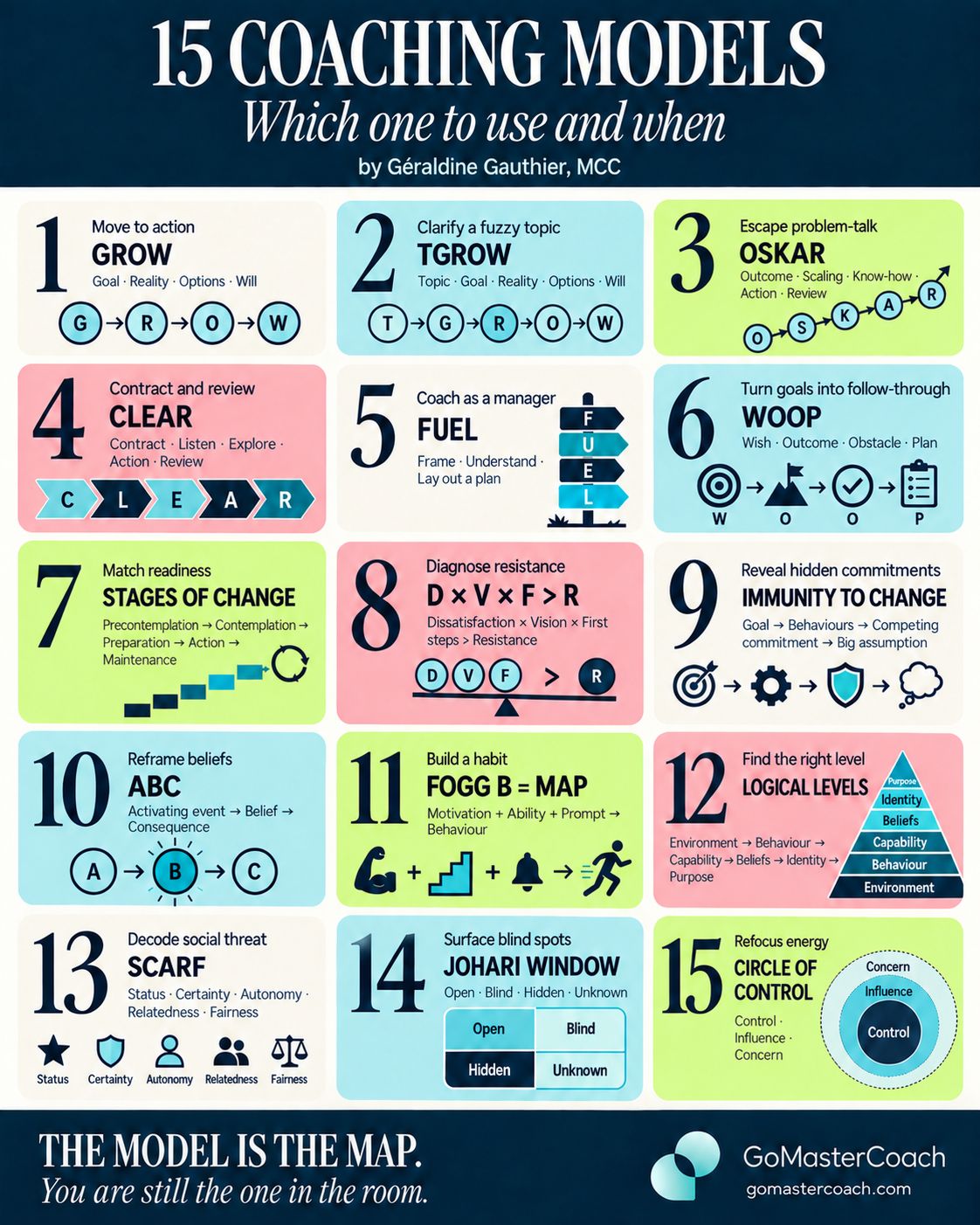
Here they are, grouped by what they are for.
How to read this guide
Three families:
Conversation models structure a session from start to finish.
Change and behaviour models explain why people do not do what they say they want to do.
Awareness models help a client see something they could not see alone.
For each: what it is, when to use it, the questions, and where it breaks.
Part 1: Conversation models
1. GROW
What it is. Goal, Reality, Options, Will. Developed by Sir John Whitmore in the 1980s. The most used coaching model in the world, and for good reason: it maps how a decision actually gets made.
When to use it. A client with a clear-ish problem who needs to get to action. First sessions. Manager 1:1s. Anytime you feel the conversation drifting.
Questions.
Goal: What do you want to walk out of here with?
Reality: What is actually happening right now? What have you already tried?
Options: What could you do? What else? And if that were not an option?
Will: What will you do, by when? On a scale of 1 to 10, how committed are you?
Where it breaks. GROW assumes the client knows the goal. Often the goal is the problem. A client who says "I want to be more productive" needs a conversation about what productivity is protecting them from, not an options list. Do not force Goal in the first five minutes.
2. TGROW
What it is. GROW with a T in front: Topic. Added by Myles Downey to separate the broad theme ("my team") from the specific goal for this session ("decide whether to have the conversation with Sam this week").
When to use it. When clients arrive with a big, fuzzy subject. Topic gives them permission to think out loud before you narrow.
Questions.
Topic: What is on your mind? What about this matters most today?
Goal: Out of all of that, what would be useful to leave with in the next 45 minutes?
Where it breaks. Same as GROW. It is a sequencing tool, not a depth tool.
3. OSKAR
What it is. Outcome, Scaling, Know-how, Affirm and Action, Review. A solution-focused model from Paul Z. Jackson and Mark McKergow. It spends almost no time on the problem and almost all its time on what already works.
When to use it. Clients stuck in problem-talk. Teams with low morale. Anyone who has analysed their situation to death and needs energy, not more insight.
Questions.
Outcome: If this were solved, what would be different tomorrow morning?
Scaling: On a scale of 0 to 10, where are you now? What makes it a 4 and not a 2?
Know-how: What has worked before, even slightly?
Affirm and Action: What is one small step you could take this week?
Review: What is better since last time?
Where it breaks. Some clients need to be heard before they can be scaled. If you go to "what's working" too fast, it lands as dismissal.
4. CLEAR
What it is. Contracting, Listening, Exploring, Action, Review. Peter Hawkins' model, older than GROW. Its distinctive move is the front and back: an explicit contract at the start and a review of the process at the end.
When to use it. Executive coaching. Systemic or team coaching. Any engagement where boundaries, confidentiality and "what are we actually here to do" need to be said out loud.
Questions.
Contracting: What do you want from me in this session? What do you not want?
Listening: (say less, notice more)
Exploring: What is this really about for you?
Action: What will you do differently?
Review: What was useful in how we worked today? What would you change?
Where it breaks. It can feel formal for a quick corridor conversation. Use it fully for engagements; use only the Contract and Review lines in short check-ins.
5. FUEL
What it is. Frame the conversation, Understand the current state, Explore the desired state, Lay out a success plan. From Zenger and Stinnett's The Extraordinary Coach. Built for managers, not professional coaches.
When to use it. Leaders who coach their own teams. Performance conversations. Feedback that needs to land as development, not verdict.
Questions.
Frame: Here is what I would like to talk about. What would make this useful for you?
Understand: How do you see the situation? What is the impact?
Explore: What would great look like?
Lay out: What is the first step? What support do you need from me?
Where it breaks. The manager still holds the agenda. That is fine in a line relationship, but it is not pure coaching. Be honest about which hat you are wearing.
6. WOOP
What it is. Wish, Outcome, Obstacle, Plan. Gabriele Oettingen's evidence-based method, built on twenty years of research into mental contrasting. Its edge over most goal models: it forces the client to name the internal obstacle, then pre-decide the response ("if X, then Y").
When to use it. Clients who set goals and do not follow through. Habit change. Anyone who is great at vision and weak at Tuesday afternoon.
Questions.
Wish: What do you want in the next four weeks that is challenging but possible?
Outcome: What is the best thing about achieving it? Picture it.
Obstacle: What inside you gets in the way? Not your boss. You.
Plan: If [obstacle] shows up, then I will [action].
Where it breaks. WOOP is for one wish at a time. Used on a life plan it becomes noise.
Part 2: Change and behaviour models
7. The Stages of Change (Transtheoretical Model)
What it is. Prochaska and DiClemente's map of how people change: Precontemplation, Contemplation, Preparation, Action, Maintenance (and Relapse). It came out of addiction research and applies to every behaviour change I have ever coached.
When to use it. Before you push for action. Diagnose the stage first. A client in Contemplation who gets an action plan will nod, then disappear.
Questions.
Precontemplation: What would have to be true for this to become a problem worth solving?
Contemplation: What are the pros of changing? And of staying the same?
Preparation: What is the smallest first move?
Action: What is helping you keep going?
Maintenance: What would a slip look like, and what is your plan for it?
Where it breaks. People do not move through stages in order. Expect loops.
8. The Change Formula: D × V × F > R
What it is. Dissatisfaction × Vision × First steps must be greater than Resistance. Attributed to Gleicher, popularised by Beckhard and Harris. The multiplication matters: if any factor is zero, change is zero.
When to use it. Diagnosing why a client, or a team, or an organisation, is not moving. It tells you which lever to pull.
Questions.
D: What is the real cost of staying where you are? What will it cost in two years?
V: What does the other side look like? Can you describe a Tuesday there?
F: What is one step you could take before Friday?
R: What are you protecting by not changing?
Where it breaks. It is a diagnostic, not a process. Once you know the missing factor, switch to another model to work it.
9. Immunity to Change
What it is. Kegan and Lahey's four-column map: the improvement goal, what you do instead, the hidden competing commitment, and the big assumption underneath. It explains why smart, motivated people sabotage their own goals: they are keeping a promise to themselves they have never said out loud.
When to use it. Recurring patterns. The client who has "tried everything". Leaders who want to delegate and never do.
Questions.
Column 1: What are you committed to improving?
Column 2: What do you do, or not do, that works against it?
Column 3: If you imagine doing the opposite of column 2, what worry comes up? What are you also committed to?
Column 4: What must be true, in your world, for that worry to make sense?
Where it breaks. It takes a full session, sometimes two. And it needs a client ready to be uncomfortable. Not a first-meeting tool.
10. The ABC Model (CBT)
What it is. Activating event, Belief, Consequence. Albert Ellis's core insight: it is not the event that creates the feeling, it is the belief about the event. Coaching works on B.
When to use it. Strong emotional reactions to specific situations. Rumination. "My boss did X and I felt Y."
Questions.
A: What exactly happened? Just the facts a camera would record.
B: What did you tell yourself about it?
C: And what did you feel and do as a result?
Then: What else could that event mean? What would you tell a friend who believed that?
Where it breaks. Coaching stays in the present and future. If the belief is rooted in trauma or the pattern is clinical, this is a referral, not a session.
11. The Fogg Behaviour Model: B = MAP
What it is. Behaviour happens when Motivation, Ability and a Prompt converge at the same moment. BJ Fogg's research at Stanford. Most coaches over-work motivation. Fogg's point is that ability and prompts are cheaper levers.
When to use it. Habit design. "I know what to do, I just don't do it." Turning insights into things that happen on a Tuesday.
Questions.
Motivation: How much do you actually want this, honestly, 1 to 10?
Ability: How could you make it so small it is almost embarrassing?
Prompt: What already happens every day that this could attach to?
Where it breaks. Fogg is for behaviour, not meaning. Do not shrink a purpose question into a tiny habit.
12. Logical Levels (Dilts)
What it is. Robert Dilts' hierarchy from NLP: Environment, Behaviour, Capabilities, Beliefs and Values, Identity, Purpose. Change at a higher level cascades down. Change at a lower level rarely cascades up.
When to use it. When the client keeps fixing the wrong level. Someone who has taken three time-management courses (capability) and still overworks (identity: "I am the one who holds it together").
Questions.
Environment: Where and when does this happen?
Behaviour: What do you actually do?
Capability: What skills are in play, or missing?
Beliefs: What do you believe about this? What has to be true?
Identity: Who are you being when you do this?
Purpose: What is this in service of?
Where it breaks. Going to Identity too early feels invasive. Earn it.
Part 3: Awareness models
13. SCARF
What it is. Status, Certainty, Autonomy, Relatedness, Fairness. David Rock's neuroscience-based model of the five social threats and rewards the brain tracks constantly. A threat to any of the five triggers the same response as a physical threat.
When to use it. Conflict. Resistance to change. A client who "overreacted" to feedback and cannot explain why. Leaders designing a reorg.
Questions.
Which of the five was threatened in that moment?
What did you need that you did not get?
If you were leading this change, how would you protect people's certainty and autonomy?
Where it breaks. It explains the reaction. It does not resolve it. Pair with ABC or GROW.
14. The Johari Window
What it is. Luft and Ingham's 2×2: what is known to self and others (Open), known to others but not self (Blind), known to self but not others (Hidden), and known to neither (Unknown). Coaching expands the Open window.
When to use it. Feedback debriefs. 360 results. Clients who receive the same comment from three people and dismiss it three times.
Questions.
What do people consistently say about you that you do not recognise?
What do you know about yourself that you never let others see at work?
What would change if that were in the open?
Where it breaks. It is a frame, not a method. Use it to structure a debrief, not to run a session.
15. Circle of Control
What it is. Covey's three circles: what you control, what you can influence, what you can only be concerned about. Simple to the point of being underrated.
When to use it. Overwhelm. Victim language. The first ten minutes with a client who is venting about everything and everyone.
Questions.
Of everything you just said, what is fully yours to decide?
What could you influence if you chose to?
What are you spending energy on that belongs in the outer circle?
Where it breaks. Used too early it can feel like "stop complaining". Let them empty the bucket first.
Which model, when: a quick decision map
The client is...
Start with
Clear on the problem, needs action
GROW or TGROW
Drowning in problem-talk
OSKAR
Starting a formal engagement
CLEAR
A manager coaching their own team
FUEL
Setting goals they never keep
WOOP, then Fogg
Saying "I should change" but not moving
Stages of Change, D×V×F>R
Repeating a pattern they hate
Immunity to Change, Logical Levels
Reacting strongly to one event
ABC, SCARF
Debriefing feedback
Johari Window
Overwhelmed and venting
Circle of Control
What the models do not do
They do not replace listening. They do not replace silence. They do not replace the moment you notice the client's voice drop on "I'm fine" and decide to ask about it.
I have watched coaches run GROW so precisely the client felt processed. And I have watched coaches with no model at all produce a shift in four minutes because they noticed one word.
The model is the map. You are still the one in the room.
Pick three. Learn them until you forget you are using them. Then break them on purpose.
Get the full guide
I have put the 15 models into a one-page-per-model workbook: definitions, when to use, the full question set, and a worked example for each.
And if you want to practise them with real clients, real feedback and an MCC watching, our next ICF-accredited intake starts soon. Join a free info session.
Géraldine Gauthier, MCC, is the founder of GoMasterCoach, an ICF-accredited coach training school with 600+ graduates across Singapore, Europe and the Americas.

.svg)

.svg)
.webp)


.webp)





.jpg)