Am I Coachable? 5 Signs You're Not Ready for Coaching (Yet)
Géraldine Gauthier
15 Jul 26
|
7 Min
|
Quick answer: Being coachable means you're willing to question yourassumptions, consider challenging perspectives, and take ownership of your growth. After training 1,000+ people, the difference between breakthrough anddisappointment is rarely intelligence or ambition: it's readiness. Coachability is a skill you can build.
Key Takeaways
Coachability is about readiness, not intelligence or ambition.
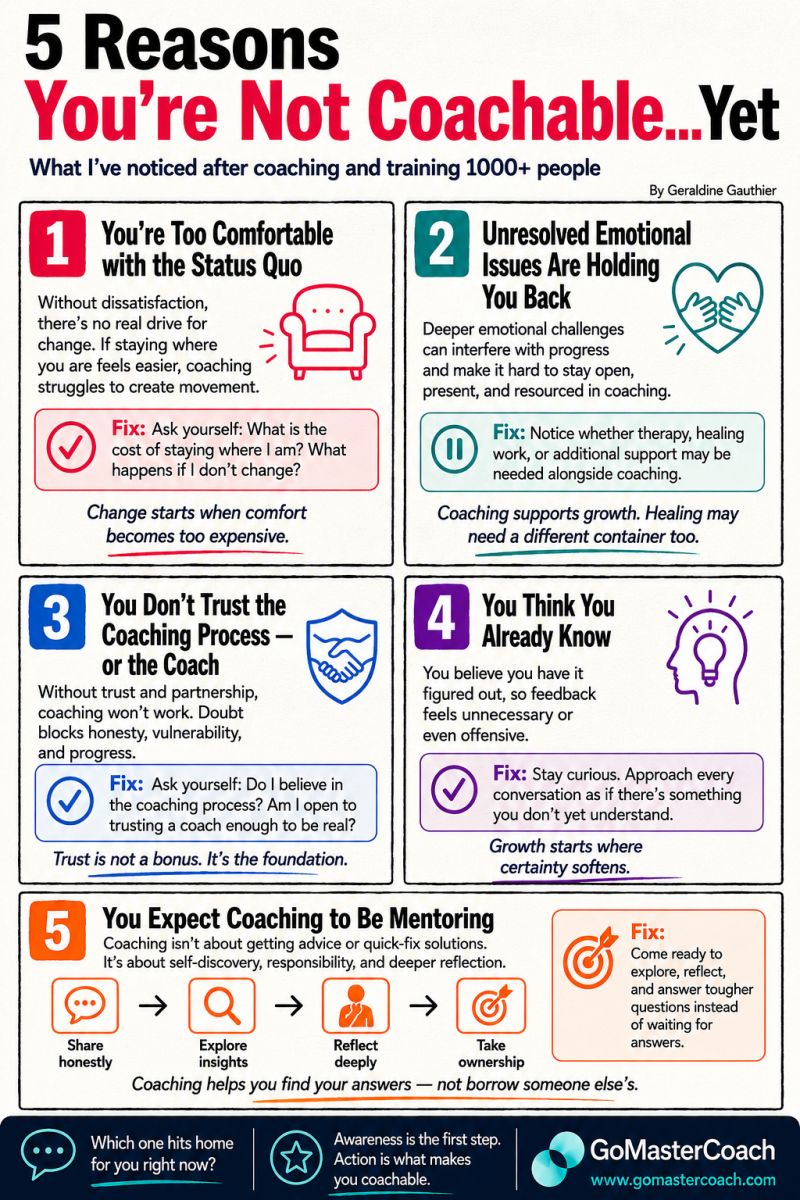
The 5 signs you're not coachable yet: too comfortable, unresolved emotional weight, no trust, falsecertainty, expecting mentoring.
Coaching moves you forward; therapy heals the past. Knowing which you need is itself a sign ofcoachability.
You can become morecoachable. It's a trainable skill, not a fixed trait.
The strongest coaches are the most coachable people first.
After training and coaching more than 1,000 people, I've noticed something surprising.
It's almost never about intelligence.
It's rarely about ambition.
It's about readiness.
Some people arrive expecting a breakthrough and feel disappointed after a few sessions. Others transform almost immediately. The difference usually comes down to one thing: whether they're truly ready to be coached.
If you're considering professional coach training, or wondering whether coaching is your right next step, these are the five signs I see most often, and exactly how to move past each one.
What Does It Mean to Be Coachable?
Short answer: Being coachable means you're willing to question your own assumptions, consider perspectives that challenge you, and takeresponsibility for your growth. It doesn't mean agreeing with your coach or having the answers it means staying open enough to look for them.
The International Coaching Federation (ICF) defines coaching as a partnership that helps clients maximise their personal and professional potential. A partnership only works when both people are fully engaged.
Coachability isn't about having all the answers. It's about being willing to look for them.
1. You're Too Comfortable with the Status Quo
Short answer: You're not coachable yet if you're too comfortable. Without real dissatisfaction, there's no fuel for change, and coaching can't manufacture it for you. The fix: get honest about the true cost of staying exactly where you are.
Coaching isn't about fixing people. It's about helping people move from where they are today to where they want to be.
One useful model is Beckhard's Change Formula:
D × V × F > R
(Dissatisfaction × Vision × First Steps > Resistance)
If dissatisfaction isn't strong enough, resistance wins. So instead of asking, “Should I get a coach?” ask:
“What's the cost of staying exactly where I am?”
Sometimes that one question creates more momentum than any coaching exercise.
2. Are Unresolved Emotional Issues Holding You Back?
Short answer: Coaching moves you forward; it doesn't heal the past. If unresolved emotional pain is driving the wheel, therapy is the right first step, not coaching. Knowing the difference isn't a weakness: it's the self-awareness that makes you coachable.
Coaching focuses on future goals, awareness, and action.
Therapy focuses on understanding and healing past experiences.
A useful filter: Is this a coaching goal… or a therapy goal?
3. Do You Trust the Coaching Process and the Coach?
Short answer: Coaching runs on trust. If you don't believe the process can help, or you can't be fully honest with your coach, the work stays shallow. Real transformation requires a partnership you're willing to lean into completely.
Trust creates partnership. Partnership creates transformation. Ask yourself three questions:
1. Do I believe coaching can help me?
2. Am I willing to trust the process?
3. Am I ready to be completely honest?
Sometimes coaching doesn't work because the client isn't ready. Sometimes the coach simply isn't the right fit. Both are worth naming early.
4. Do You Think You Already Know?
Short answer: Certainty kills coaching. If you already think you know, you stop exploring, listening, and growing. Coachable people trade “I know” for “What am I missing?” and that single shift changes everything.
Coaching invites better questions:
What haven't I consideredyet?
What assumptions am Imaking?
What might I be avoiding?
The strongest coaching conversations begin with curiosity, not expertise.
5. Do You Expect Coaching to Be Mentoring?
Short answer: Coaching isn't mentoring. If you're waiting to be told what to do, you'll be frustrated. A coach doesn't hand you answers: they ask the questions that surface your own. Come ready to do that work.
Here's the difference:
Role
What they do
Mentor
Shares their experience
Consultant
Offers solutions
Coach
Asks questions that help you find your own answers
This distinction is one of the foundations of the ICF Core Competencies, which place the client, not the coach, at the centre of the conversation.
How to Become More Coachable: 5 Steps
Short answer: You can build coachability. It's a skill, not a fixed trait. Name your real dissatisfaction, separate coaching goals from therapy goals, practise receiving feedback without defending, replace certainty with curiosity, and choose the right coach while committing to full honesty.
1. Name your real dissatisfaction. Write down the actual cost of staying where you are. Momentum starts here.
2. Sort coaching goals from therapy goals. Ask whether each goal is about building forward or healing back, then choose the right support.
3. Receive feedback without defending. Notice the urge to explain. Pause. Ask one more question instead of justifying.
4. Replace certainty with curiosity. Before each session, list what you might be assuming or avoiding.
5. Choose the right coach and commit to honesty. Fit matters. So does your willingness to be fully seen.
The Best Coaches Are Coachable First
After training hundreds of coaches, one pattern is undeniable: the strongest coaches are also the most coachable.
They receive feedback. They reflect on their assumptions.They keep practising. They keep learning.
That's why our graduates keep developing long after certification, through our Peer Coaching Community, ongoing mentoring, and the Digital Coaching Toolbox. Becoming a great coach isn't about finishing a course. It's about committing to lifelong learning.
FAQ: Coaching Readiness
What does it mean to be coachable?
Being coachable means you're willing to question your assumptions, consider other perspectives, and take responsibility for yourg rowth. It doesn't mean agreeing with everything your coach says.
How do I know if I'm ready for coaching?
You're ready when you feel real dissatisfaction with the status quo, you trust the process, you're open to honest feedback, and you're willing to find your own answers rather than be told what to do.
What makes someone uncoachable?
Someone is uncoachable when they're too comfortable to change, carrying unresolved emotional pain better suited to therapy, unwilling to trust the coach, certain they already know, or expecting to be told what todo.
What's the difference between coaching and therapy?
Coaching focuses on future goals, awareness, and action. Therapy focuses on understanding and healing past experiences. If your goal is about healing the past, that's usually a therapy goal, not a coaching goal.
Can you become more coachable?
Yes. Coachability is a skill, not a fixed trait. It grows as you build self-awareness, tolerate discomfort, and practise receiving feedback without defending.
How long does it take for coaching to work?
It depends on readiness. Coachable clients often notice shifts within the first few sessions, while resistance or misaligned goals slow progress regardless of the coach's skill.
Do the best coaches need to be coachable?
Absolutely. The strongest coaches are the most coachable: they keep receiving feedback, questioning their assumptions, and learning long after certification.
About the Author
Géraldine Gauthieris a Master Certified Coach (MCC), the International Coaching Federation's highest credential, held by roughly the top 4% of coaches worldwide. She is the founder of GoMasterCoach, an ICF-accredited coach training platform, and has trained and coached more than 1,000 leaders, managers, and aspiring coaches across Asia, Europe, and the Americas.
Ready to Explore Coach Training?
If this article resonated, it might be a sign to explore your next step. Whether you're curious about becoming a coach or wondering whether professional coach training is right for you, we'd love to meet you.

.svg)

.svg)

.webp)

.webp)




.jpg)



.png)